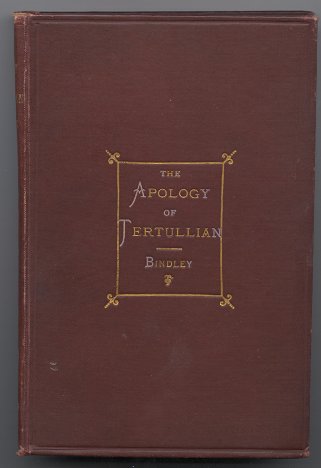
T.H. BINDLEY, The Apology of Tertullian (1890)
Q. S. F. Tertulliani Apologeticus Adversus Gentes pro Christianis. Edited, with Introduction and Notes, by T. H. BINDLEY, M.A., Merton College, Oxford. (Clarendon Press.)
Spectator, Sept. 28. "The Apology for the Christians is one of the most interesting and useful of Tertullian's treatises, and we welcome this scholarly edition with especial pleasure. The work might advantageously be recommended to Candidates for Holy Orders by the Bishops' examining chaplains, for it contains within a brief compass much that is valuable on questions of dogmatics, apologetics, and early Church history. . . . The plan and execution of this edition are both good, the annotations being an advance upon anything of the kind we have seen in English."
Saturday Review, Nov. 9. "We have to thank Mr. Bindley for a good edition of one of the most interesting documents of the early Church, the Apology of Tertullian. Mr. Bindley has read up his subject thoroughly, and gives the results of his studies in a compact and serviceable form. Language, doctrine, ritual, and archaeology have, each and all, received due attention, and for examination purposes, perhaps, nothing more could be desired."
THE APOLOGY
OF
TERTULLIAN
FOR THE CHRISTIANS.
Translated with Introduction, Analysis, and Appendix
containing the Letters of Pliny and Trajan
respecting the Christians,
BY
T. HERBERT BINDLEY, M.A.
MERTON COLLEGE, OXFORD.
--------o---------
Parker and Co.
6 SOUTHAMPTON-STREET, STRAND, LONDON
AND BROAD-STREET, OXFORD.
1890.
PRINTED BY PARKER AND CO.,
CROWN YARD. OXFORD.
THE present volume grew naturally out of my special study of the APOLOGETICUS of Tertullian when preparing an annotated edition for the Delegates of the Clarendon Press. It is hoped that this translation may be helpful to Theological students who are at work upon the original text, and for them it has been more particularly prepared. Yet it is not unlikely that there will also be some English readers interested in the early records of Christianity who may be glad to possess this famous apologetic tract of the second century, and to whom its presentation in an English dress will be acceptable. The translation is made from the text of the Clarendon Press edition (Oxford : 1889).
T. H. B.
Ixworth,
November 19, 1889.
CORRIGENDA.
----
Page 4, line 5 from bottom, for of which the criminal is proud, read to be found guilty of which is a man's pride,
Page 23, line 2, for II. 1. read II. i.
Page 30 note, for Latiari. read Latiaris.
Page 34, line 21, for II. I. read ii. i.
THE life of Tertullian, so far as we know it, may be briefly told. He was born at Carthage about the year A.D. 160, and was brought up amid the pagan surroundings of that provincial metropolis. His father, whose name is not known, was a centurion in attendance upon the proconsul of Africa, and he took care that his son, who was probably intended for public life, should receive an excellent education in the celebrated schools of his native city. Before his conversion it is believed that Tertullian practised in the provincial law-courts; and the constant recurrence of legal phraseology in his writings bears out the truth of Eusebius' statement that he was intimately acquainted with Roman law (H. E. ii. 2). That he was also well versed in the art of rhetoric, the reader of the APOLOGY will at once admit: the arguments are accumulated with the skill, and sometimes with the one-sidedness, of an advocate holding a brief in his own case, and pleading with an impassioned earnestness born of deep personal conviction.
Tertullian's conversion may be dated in 196 1, and he was ordained priest in the Carthaginian Church. He was married, but childless. His character reflects |viii the typical African temperament,—fervid, impatient, impetuous, and with a considerable vein of latent puritanism. It was this unrestrained impulsiveness of nature that soon beguiled him to break away from the wise moderation of rhe Church and to embrace the heresy of Montanus,—a Phrygian fanatic, who claimed to be the recipient of a new Revelation of the Paraclete, and whose system of discipline was rigorously severe. The lapse of so gifted a champion of the faith was, as Vincent of Lerins tells us (Common. 18), a severe temptation to the Church, and his later error naturally 'cast some discredit on the authority of his approved writings' (Hil. in Matt. 5).
Tertullian lived to an extreme old age, according to the report mentioned by Jerome (de vir. illustr. 53), and his death may be placed about the year 240. A small sect, called after him 'Tertullianists,' lingered in Carthage to the time of Augustine (Haer. 86).
The APOLOGY was written in the year 197, very soon after his conversion, and the reader may, happily, forget the subsequent lapse of its author into heresy. The work is one of the best and most interesting examples of Western apologetic writings, both on account of the cogency and brilliance of its defensive pleading for Christianity, and from the graphic picture which it portrays of paganism as it existed in the great metropolis of Africa particularly, and in the Roman Empire generally, at the close of the second century. It may be said at once that there is much in this picture which is painful; few English readers will have been prepared for the hideous disclosures |ix which Tertullian's exposure of heathenism necessarily entails; yet it may prove a useful lesson, if it in any way brings home to us what and how deep was the moral darkness of the world which it was the divine office of the Christian Church to enlighten and purify.
The immediate purpose of the APOLOGY was to protest against the wholesale condemnation of a body of men on the mere presumption of a criminality which had never been proved. The inveterate hostility manifested towards the Christians forbade them the rights even of ordinary criminals. They were prosecuted under the laws, and persecuted by a panic-stricken populace, whose unreasoning animosity, and ignorance of the true nature of the Christian religion, led to the formulation of execrable charges which the Christian Apologists had to meet and repel 2. Some of these, e.g. those in ch. 7—9, were due to the close bonds which united the Christians together in a true fraternity, and to the care with which they shielded the higher mysteries of their religious worship from any risk of profanation by the heathen outsiders 3. Others again, e.g. those in ch. 40-44, arose from mere popular irrational dislike, which seized anything as a handle against a section of society whose purity and integrity of life were a standing rebuke to the dissolute morals of the age.
The two main charges brought against the Christians,—Sacrilege and Disloyalty to the Emperor,— |x stood on a different base. They were reasonable enough from the heathen point of sight, and the Apologist could only refute them by attacking the whole groundwork and fabric of the Roman religion of the time. This attack upon paganism is carried on simultaneously with the defence of Christianity. Tertullian's favourite weapon is sarcastic retort, and his pagan readers must have winced, not once nor twice only, under the lash of his stinging epigrams and biting irony.
The APOLOGY naturally contains but few references to the internal life of the Church. Sufficient is related to disarm the suspicions of the heathen, but no more. A full statement of Christian doctrine or mode of worship is not to be looked for. This reserve, which is maintained by all the Apologists when addressing those outside the Church, is significant of their jealous reverence for the sanctity of their faith. Hence those passages are the more valuable and interesting which treat of the Being of God, of the Divinity of Christ, the God-Man, and His earthly life (ch. 17—21), and of the nature of the bond of Christian unity (ch. 39). It will be observed that the only passage adduced from the New Testament4 in the whole of the APOLOGY (i Tim. ii. 2; see ch. 31) is quoted merely in self-defence on a point of Christian practice. |xi
1. a So Pusey and others : see, however, Plummer, Church of the Early Fathers, p. 112.
2. b Comp. Lightfoot, Philippians, pp. 26 ff.
3. c Comp. Gore, Christian Ministry, pp. 30 f.
4. d See Lightfoot, Supernatural Religion, p. 275, where for 'New Testament' we should, I think, read 'Gospels.' So Westcott in the passage referred to in Lightfoot's note (History of the Canon, pp. 116 f.).
I. PREFACE.
1. It is unjust to condemn the Christian religion unheard and unknown (ch. i).
We are denied the rights of ordinary criminals, and the use of torture is most inconsistently employed in our case.
The mere name of 'Christian' is made criminal (ch. 2).
The blindness of your hatred over-reaches itself and involuntarily eulogizes us (ch. 3).
2. We propose to refute and retort every charge you bring against us; but first let us examine the nature of the laws under which we are condemned (ch. 4). They are to be traced to an ancient decree, and to the rescripts of the worst emperors (ch. 5). But your ancient decrees are perpetually being ignored by yourselves, both as regards personal and social questions, as well as religious restrictions (ch. 6).
II. REFUTATION OF THE PRINCIPAL ACCUSATIONS.
i. Secret crimes.
We are accused of infamous secret atrocities,—infanticide, a feast of blood, and incest; though no proof has ever been forthcoming, and only rumour is responsible for the charge (ch. 7). Whereas natural instinct would revolt from such crimes, and the burdened conscience of one unwittingly led to perpetrate them would be intolerable (ch. 8).
You yourselves are guilty of sacrificing children and adults in your worship of various deities, and of eating blood in several loathsome rites and horrible repasts; |xii whereas your knowledge of our horror of eating blood is evidenced by the tests which you apply to us. Incest, too, is one of your commonest crimes (ch. 9).
ii. Open crimes.
I. Sacrilege.
We are accused of Sacrilege and Disloyalty to the emperor.
We shall prove that your gods are no gods, for they once were men (ch. 10); and no reasons exist for their subsequent deification, since their aid in Nature is, and always has been, unnecessary, while their gross immoralities would rather condemn them to Tartarus than raise them to Heaven (ch. II).
Your gods are nothing but names of dead men, and images made of the commonest materials, which you treat with the same indignities that you heap upon us (ch. 12). In fact, you act most sacrilegiously towards your gods, whether private or public (ch. 13); for you cheat them in your sacrifices, and mock them in your poetic and philosophic literature (ch. 14). You insult them in your burlesques and at your theatres (ch. 15).
You hold grotesque views respecting our Deity. We neither worship an ass's head, nor the Cross, nor the Sun, nor a biformed monstrosity resembling some of your gods (ch. 16).
We worship one God, the Omnipotent and Invisible Creator, to Whom Nature and the human soul bear witness (ch. 17), Who hath given us a revelation of Himself through Scriptures and Prophets, whose writings are open to all (ch. 18). The antiquity of these writings proves their trustworthiness; for they are more ancient than your oldest records (ch. 19); and their majesty and divinity are proved by the daily fulfilment of their predictions (ch. 20). |xiii
We worship the same God as the Jews, but, Unlike them, we acknowledge Christ, the Son of God, to be God. He is the True Word, Reason, and Power of God, Who, begotten eternally by His Father, and being Co-essential with Him was made Flesh. The Jews misunderstood His Advent, His Work, and His Doctrine. They put Him to death, but He rose from the dead, as was predicted, and after forty days ascended into Heaven. Meanwhile His gospel is being spread throughout the world by His disciples (ch. 21).
We, with your philosophers, assert the existence of daemons, spiritual beings of malefic power, who falsely claim to be divine (ch. 22). These daemons and your gods are identical, as their own confession when confronted by a Christian will prove. Further, you may learn from them Who is the True God. Our dominion over them is derived from the power of Christ (ch. 23).
Your charge of sacrilege thus falls to the ground, for there can be no religious duties towards gods that have no existence. In any case, we claim the civil right of religious liberty, which you grant to every one but us (ch. 24).
You assert that Roman prosperity is due to Roman piety. Yet your chief deities are foreigners, who once reigned on earth, and therefore must some time have worshipped your earliest deities. Besides, your elaborate piety is of later growth than your prosperity, which has in reality been advanced by your impieties (ch. 25).
All rule and sovereignty are in the gift of the One God Who is above all (ch. 26).
Your animosity against us is incited by daemoniacal agency (ch. 27).
2. Disloyalty.
You are driven by the same evil influence to |xiv force us to sacrifice for the emperor's welfare. This we refuse to do, and are therefore accused, secondly, of Disloyalty to Caesar (ch. 28).
The gods are the creatures of Caesar, and cannot therefore have his welfare in their keeping (ch. 29).
We offer for Caesar's welfare prayers and true sacrifices to the True God, in Whose hands alone it is (ch. 30). And our prayers for him are no pretence, but part of our bounden religious duty (ch. 31), and rendered necessary by our belief that the continuance of the Roman Empire delays the end of the world (ch. 32).
We are in fact far more truly loyal than you are; for we recognize the Divine will in the appointment of the Caesars, although we refuse to acknowledge the divinity of the Caesars themselves (ch. 33).
'Lord' is no proper title of Caesar, but belongs to God (ch. 34). Yet we are called 'public enemies ' because we refuse to join in your useless acts of worship and disgraceful festivities. The real traitors are always found amongst yourselves, whether in the lower or higher ranks of society (ch. 35). We are necessarily well-disposed to every man whether Caesar or neighbour (ch. 36).
We are forbidden to retaliate, otherwise we might easily take our revenge, either by secret means, or as open enemies, or even by merely withdrawing from your midst, and leaving you defenceless against the attacks of the daemons (ch. 37). The Christian society ought to be recognized by the law, since it is a harmless and unambitious association (ch. 38).
III. REFUTATION OF MINOR CHARGES.
1. The purposes of our assembly are pious, pure, and charitable. Our well-known love for each other is |xv blamed, and our simple 'love-feast' denounced as extravagant (ch. 39).
2. Our existence is supposed to provoke the gods to send calamities and disasters upon the empire; yet such occurrences happened before the rise of Christianity. Your very gods, too, suffer in the calamities which are supposed to come from them. In reality, the presence of the Christians has mitigated the violence of God's judgements upon the world (ch. 40); for these judgements are attributable to your misdeeds (ch. 41).
3. You accuse us of worthlessness to trade,—a charge which is sufficiently refuted by our habits of life (ch. 42). We are certainly profitless to the bad, but this is a real gain (ch. 43).
The real loss to the state, which is involved in your injustice to us, is overlooked (ch. 44).
Our ethical standard is far higher and more awe-inspiring than yours (ch. 45).
4. Our sect is regarded as a school of philosophy; yet you refuse us the licence allowed to philosophers. Really we differ from the philosophers both in the extent and definiteness of our knowledge, and in our moral standard (ch. 46).
Philosophers have derived their wisdom from our Scriptures, which they distorted; and they have vainly speculated on subjects not revealed. Heretics, similarly, have distorted the New Testament; and many of our doctrines have been anticipatorily counterfeited by the agency of evil spirits (ch. 47).
The philosophical speculation on the transmigration of souls is admitted, but our doctrine of the resurrection of the body scouted; although Nature illustrates it, and the mystery of our present existence forbids a hasty rejection of our belief respecting the future. On this subject Revelation must suffice (ch. 48). |xvi
IV. CONCLUSION.
Why do you censure us for holding tenets which are at least harmless, if not positively beneficial (ch. 49)?
Our sufferings are our glory and triumph. How is it that in your view our endurance redounds to our discredit, while the fortitude of others meets with your approbation? You may gain popularity by your injustice, but our sufferings and practical example continually attract new converts (ch. 50).
CHAPTER I.
I. 1. The injustice of condemning the Christian Religion unheard and unknown.
IF it be not permitted you, provincial governors of the Roman Empire, presiding for the administration of justice in your open and appointed court almost at the very head of the state, to publicly investigate and openly examine what are the clear facts in the case of the Christians;—if your authority either fears or is ashamed to enquire in public concerning the clue exercise of justice in respect of this kind of offence alone;—if, in fine, hostility to this sect, carried to extremes (as was recently the case) in judgements passed upon members of your own households, bars the way to its defence;—let the truth reach your ears at all events by the secret agency of a silent writing.
Christianity pleads no excuse for her cause, for neither does she marvel at her present position. She knows that she is a sojourner upon the earth, that amongst strangers she readily finds enemies, but that her nativity, her home, her hope, her favour, her dignity are in Heaven. One boon meantime she craves, that she be not condemned unknown. What |2 is there in this request derogatory to the laws, supreme in their own sphere, if she be heard? Will not their power rather be extolled hereby, that they will condemn the truth even after she has been heard? Whereas if men condemn her unheard, besides the odium of an injustice done, they will be suspected, and justly, of not being altogether unconscious that they are refusing to hear that which, if they heard, they could not condemn.
This, then, is the first point we bring before you, —the injustice of your hatred of the Christian name. And the very pretext which seems to excuse this injustice, namely ignorance, both aggravates and clenches it. For what ran be more unjust than for men to hate that of which they are ignorant, even supposing it to deserve their hatred? For then only does it deserve hatred when it is ascertained whether it deserve it. But if a knowledge of the deserts be wanting, how is the justice of the hatred defended, which ought to be proved not from the mere existence of the hatred but from cognizance of the case? When, however, men hate because they are ignorant of the nature of the object of their hatred, what is there to prevent it really being of a nature such as they ought not to hate?
Thus in both ways we prove them wrong; namely, that they are ignorant in their hatred, and that in their ignorance they hate unjustly. A proof of their ignorance, which while it excuses their injustice, also condemns it, is found in the fact that all, who formerly hated because they were ignorant of the |3 nature of what they hated, at once cease to hate as soon as they cease to be ignorant. From being such, they become Christians, particularly when they have gained full knowledge; and they begin to hate what they had been, and to profess what they had hated; and our numbers are as great as we are computed to be. The cry is that the state is beset, that the Christians are in the rural districts, in the villages, and in the islands; it is deplored as a public calamity that persons of both sexes, of every age, of every class, even people of high rank, are going over to this name 5.
And yet not even from this very fact do men mentally advance to an appreciation of some possible good latent in our religion; they do not allow themselves a more consistent surmise; they do not welcome a closer investigation. Respecting this subject alone the natural curiosity of men lies dormant: they love to remain ignorant, while others rejoice to have learnt. How much more might Anarcharsis have stigmatized these men,—the inexperienced passing judgement on the experienced,—than the unmusical criticizing the musical! They prefer to remain ignorant, because they already hate; and by this preference they prejudge that of which they are ignorant to be such as, if known, would preclude their hatred; since if no just ground for hatred be found, the right course would obviously be to cease hating so unjustly; whereas if the justice of their hatred were to be established, not only would the hatred lose none of |4 its force, but it would actually gain a reason for its continuance from the sanction of justice itself.
'But,' it may be said, 'a thing is not therefore good because it attracts the many. What numbers are previously disposed to evil! How many desert to the side of error!' Who denies it? Nevertheless that which is truly evil, not even do those whom it sweeps along dare to defend as being good. There is a sense of shrinking or shame instinctively attached to all evil. Lastly, evil-doers crave concealment, they shun publicity, they quake when detected, they deny when accused, not even when put to the rack do they readily or invariably confess. They are undoubtedly disconsolate when condemned; in their consciences they recount their deeds, but impute to fate or the stars the promptings of an evil mind; for they refuse to acknowledge as their own what they recognize as evil. But with Christians the case is totally different. No one is ashamed; no one feels regret, except indeed that he did not become a Christian sooner. If he is censured, he glories in it; if accused, he pleads no defence; if interrogated, he even voluntarily confesses; if condemned, he gives thanks. What kind of evil, then, is this, which lacks the essential characteristics of evil,— fear, shame, prevarication, regret, sorrow? What kind of evil is this of which the criminal is proud, to be accused of which is his prayer, and to be punished for it his happiness? You cannot call this madness,—you, whose ignorance of the subject is clearly proved. |5
CHAPTER II.
We are denied the rights of ordinary criminals, and the use of torture is most inconsistently employed in our case. The name alone of 'Christian' is made criminal.
EVEN if it is certain that we as a matter of fact are the most guilty of men, why do we fare at your hands otherwise than our fellow-criminals, when surely the same treatment ought to be applied to offences of a similar nature? When others are charged with similar crimes to those we are charged with, they employ both their own right of speech and a hired advocate to maintain their innocence. The opportunity of rejoinder and cross-examination is open to them, since it is illegal for them to be altogether condemned undefended and unheard. But Christians alone are forbidden to say anything either in self-exculpation, or in defence of the truth, or in hindrance of a miscarriage of justice : attention is given to that only which is required by the public hatred,— namely, a confession of the name, not an enquiry into the charge. Whereas when you judicially examine into the case of some criminal, you are not content to pronounce the verdict at once upon his confession of the mere name of murderer, or sacrilegious or incestuous person, or public enemy (to adopt our own indictments), without eliciting the attendant circumstances,—the nature of the deed, its frequency, the place, the method, the time, the accessories, the accomplices. Yet in our case you do nothing of the |6 kind; although the information ought just as much to be extorted (whichever the charge may be that is falsely cast in our teeth), as to how many murdered infants each had already tasted of, how often incest had been committed under cover of the darkness, who were the cooks, what dogs were present. O how high would be the reputation of that magistrate who had unearthed any one who had already eaten one hundred infants! And yet we find enquiry into our case forbidden! For Pliny Secundus, when governor of a province, after the condemnation of some Christians and the degradation of others, being distressed at their very number notwithstanding, consulted Trajan the Emperor6 as to what he should do in the future, alleging that beyond their obstinate refusal to sacrifice, all he had discovered was that they were in the habit of assembling at dawn to sing to Christ as God 7, and to bind themselves together under a strict rule, forbidding homicide, adultery, fraud, perfidy, and all other crimes. Then Trajan wrote back that persons of this class were not indeed to be enquired after, but if brought up before the court, were to be punished.
What an inevitably inconsistent decision! It forbids them to be inquired after, as though innocent, and yet bids them be punished, as though guilty. It is at once lenient and merciless; it ignores while it |7 punishes. How strangely does this judgement overreach itself! If it condemns, why does it not also institute enquiry? if it does not institute enquiry, why does it not also acquit? Military stations are appointed by lot throughout every province for tracking robbers; against traitors and public enemies every civilian is in arms; the enquiry is extended further to their confederates and accomplices. The Christian is the only person against whom an enquiry may not be set on foot, though he may be produced in court;—just as if the enquiry was for any other purpose than the production before the magistrates! And so you condemn the man brought before you, though no one wished him to be sought out; a man, I take it, who did not at first deserve punishment because he was guilty, but because, being forbidden to be sought out, he was found!
Nor likewise in another point do you act towards us according to your ordinary procedure in judging criminals; for you apply torture to others, when denying, to make them confess; to the Christians alone, to make them deny; whereas if there were criminality, we should indeed deny, and you as surely would compel us under torture to confess. Nor could you pretend that an investigation of Christian criminality might be dispensed with on the ground that the mere profession of Christianity would prove it; for to this day, although cognizant of what constitutes murder, you nevertheless elicit from a confessed murderer the circumstances attendant upon the committal of the deed : whence, still more perversely, |8 having assumed our guilt from our confession of the name, you compel us under torture to retract our confession, so that in our denial of the name we may of course equally deny also the crimes of which you had presumed us guilty from our Christian profession. I must suppose of course that you do not wish us to perish, whom you believe to be the worst of men! It is doubtless your custom thus to speak to a murderer : 'Deny it;' to order one who is guilty of sacrilege to be torn in pieces if he persists in confessing it! If, then, you do not so act in the case of criminals, you thereby adjudge us to be quite free from guilt; since, assuming our perfect innocence, you will not have us persist in that confession which you know you are bound to condemn—on grounds of necessity however, not of justice.
A man exclaims, 'I am a Christian.' He tells you what he is; you wish to hear what he is not. Presiding judicially with the object of eliciting the truth, it is from us alone that you are at pains to hear falsehood. 'I am,' says he, 'that which you ask whether I am; why torture me to get a false statement? You torture me if I confess, what would you do if I denied?' Truly you are not so accommodatingly credulous in the case of others who deny; to us, upon our denial, you give immediate credence. Let this crooked dealing of yours lead you to suspect the existence of some secret hidden power, which compels you to act in opposition to the recognized forms and essentials of legal trial,—nay, in opposition to the very laws themselves. For, unless I am |9 mistaken, the laws order evil-doers to be unearthed, not to be concealed; they enjoin that confession shall lead to condemnation, not to acquittal. This is laid down by the decrees of the senate, by the commands of emperors, and by the government whose servants you are. The authority vested in you is a constitutional, not a despotic one. For with despots torture is made use of as a form of punishment; with you its use is moderated and confined to purposes of examination only. Abide by your law in this respect up to the time of confession, and if torture is anticipated by confession, it will be superfluous. Sentence must be pronounced : the culprit must be discharged from the obligation of the penalty by undergoing it, and must not be released from it. No one, in fact, desires to acquit him; it is not lawful to wish it; and therefore no compulsion is put upon any one to deny. You regard a Christian as a man guilty of every crime, hostile to the gods, to the emperors, to the laws, to morals, to all the dictates of nature; and yet you compel him to deny that you may be able to acquit him; for his denial will alone allow you to do so. You are in collusion to defeat the laws. You wish him to deny that he is guilty, so that you may return him as guiltless (though very much indeed against his will), and not as a criminal, in respect of his past life. Whence comes this perversion of intellect which neither leads you to grasp the fact that more credit is to be given to a voluntary confession than to a compulsory denial, nor to consider the possibility that, if the accused is compelled to deny, |10 he may deny untruly, and when acquitted, straightway behind your tribunal laugh at your malevolence, a Christian once more?
Accordingly, since in every particular you deal with us otherwise than with other criminals, by directing your efforts solely towards excluding us from the use of this name (for we are excluded if we consent to perform certain actions like others who are not Christians 8), you can well understand that there is no question of crime in the case, but only of a name,— a name persecuted by some system of malevolent agency which aims primarily at making men refuse to gain a clear knowledge of what they know they are clearly ignorant of. Consequently they both believe things of us which are unproven, and they refuse to have them enquired into, fearing that they should be proved to be other than they prefer men to believe them to be; their object being that the name which is opposed to that hostile system may be, by its own confession alone, condemned on the presumption, not the proof, of criminality. Hence we are tortured if we confess, and are punished if we persist, and are acquitted if we deny, because the contention is about a name. |11
Why, lastly, do you read out from the judicial tablet that so and so is a Christian, why not add that he is a murderer? If a Christian be a murderer, why not also a committer of incest, or anything else you credit us with being? Is it in our case alone that you are too much ashamed or disgusted to give the exact names of our offences when you pronounce the verdict? If a Christian is guilty of no crime, it is indeed a dangerous name if the crime lies in the name alone.
CHAPTER III.
The blindness of your hatred over-reaches itself, and involuntarily eulogizes us.
WHY, the majority in their blindness are so driven into hatred of it, that even while bearing good testimony to any one they join with it reproach of the name: 'A good man, Caius Seius, only he is a Christian.' Or again, 'I wonder at a sensible man like Lucius suddenly becoming a Christian.' No one considers whether it is not because he is a Christian that Caius is good, and Lucius prudent, or therefore a Christian because prudent and good. They praise what they know, they blame what they are ignorant of; and what they do know they mar by their ignorance, although it would be more equitable to form a judgement upon the hidden from the seen than to condemn the seen from the hidden.
Others stigmatize on the very grounds on which they praise them, those whom they knew formerly in |12 their pre-Christian days as vagabonds, worthless, and base. In the blindness of their hatred they are driven into pronouncing a eulogium. 'What a woman! how wanton, how gay! What a youth! how profligate, how licentious! They have become Christians.' Thus the name is credited with their reform. Some even strike a bargain between their own interests and such hatred, being content to suffer loss, provided only they can rid their homes of the objects of their hatred. The husband, no longer jealous, casts off his wife now chaste : the father, formerly patient, disinherits his son now dutiful: the master, formerly mild, banishes from his sight his slave now faithful: each one, as he is reformed by this name, becomes offensive. The improvement counts for nothing in comparison with hatred of the Christians.
Now then, if this hatred is directed against the name, what is the guilt attaching to names? What accusation can be brought against words, except that a certain pronunciation of a name sounds barbarous, or is unlucky or abusive or obscene? But 'Christian,' as far as its etymology goes, is derived from 'anointing.' And even when it is incorrectly pronounced by you 'Chrestian 9' (for not even is your acquaintance with the name accurate), it is formed from 'sweetness' or 'kindness.' In innocent men, therefore, even an innocent name is hated.
But you will say that the sect is hated at all events on account of its Founder's name. Yet what is there |13 novel in the fact of any school taking an appellation for its adherents from its master's name? Are not the philosophers named from their masters, Platonists, Epicuraeans, Pythagoreans? and even from their places of meeting and resort, Stoics, Academics? physicians too from Erasistratus, grammarians from Aristarchus, and even cooks from Apicius? Nor does this adoption of the name, transmitted with the system from its founder, offend any one. Of course if any one proves the sect to be a bad one, and consequently its Founder to be a bad man, he will also prove the name bad and deserving of hatred from the guilt of the sect and its Founder. It were therefore proper, before hating the name, first to form a judgement either of the sect from its Founder, or of its Founder from the sect. But now, without any investigation or knowledge of either, the name is seized upon and made the subject of attack, and a single word pre-condemns the sect and its Founder, both alike unknown,—and all because they are so named, not because they are convicted of guilt.
CHAPTER IV.
2. We propose to refute and retort every charge you bring against us; but first let us examine the nature of the laws under which we are condemned.
AND so, having as it were prefaced thus much for the purpose of holding up to contempt the injustice of the public hatred towards us, I will now take up |14 a position for the defence of our innocence; nor shall I merely refute what is laid to our charge, but also retort the charges upon those who make them; so that from this also all may know that those crimes are not to be found amongst Christians which our accusers are well aware do exist amongst themselves; and that at the same time they may be put to the blush, being as they are accusers (respecting whom I will not say that they are the worst of men posing as accusers of the best, but) of those who are from their point of view their fellow-criminals. We shall reply to each charge, both those which we are accused of perpetrating in secret, and those which we are detected in committing openly; those in which we are deemed wicked, those in which we are deemed foolish; those for which we are to be condemned, those for which we are to be ridiculed.
But whereas, since the truth of our cause meets you at every point, as a last resort the authority of the laws is set up as a barrier against it, so that either it is said that no question ought to be reopened after the laws have once decided it, or else that, however unwillingly, the necessity of obedience takes precedence of any care for the truth, I will first engage you in argument on this point of the laws, regarding you as their guardians.
First, then, how sternly you lay down this decision : 'Your existence is illegal!' And this you lay down as a preliminary objection without any more lenient modification. You exhibit violence and unjust tyrrany from out of your citadel if you therefore say it |15 is unlawful merely because you wish it, not because it ought to be so. Of course if you do not wish it to be lawful because it ought not to be so, without doubt what is wrong ought not to be lawful. And as a matter of fact, on this very ground it is already decided that what is right is lawful. If I shall find that to be good which your law has forbidden, does it not surely by that pre-decision lose the power to forbid me that which, if it were wrong, it would rightly forbid? What if your law has erred? it is I suppose of human origin, for it did not fall from heaven. Is it a matter for wonder either that man should err in framing a law, or that he should become sensible again in repealing it? Were not the laws of Lycurgus himself revised by the Spartans, and did not this revision inflict such grief upon their author that he starved himself to death in retirement? Do not you yourselves, too, day by day, in your attempts to illumine the darkness of past ages, cut down and fell with the new axes of imperial rescripts and edicts the whole of that old and tangled forest of laws? Did not Severus, that steadiest of princes, only the other day repeal those ridiculous Papian laws which bade children be brought up before the Julian law enforced marriage,—laws whose antiquity gave them such high authority? But there were laws also formerly which authorized those sentenced under them to be cut in pieces by their creditors, yet by common consent this cruelty was afterwards abolished, and a mark of disgrace substituted for capital punishment; it was thought better |16 to bring about, by the appointment of a confiscation of goods, the flush of shame rather than the rush of life-blood 10. How many laws needing amendment yet lie hidden, which neither their own antiquity nor the dignity of their framers, but their intrinsic justice alone commends; and therefore when proved to be unjust, they are deservedly to be condemned, although they condemn.
Nor are they merely unjust; they are stupid too, if they condemn a mere name. If, however, they punish deeds, why in our case do they punish deeds on the ground of a name alone,—deeds which it is determined in other cases must be proved by the committal of them, not by a name? I am guilty of incest; why do they not enquire into it? or infanticide; why do they not extort the details? I commit a crime against the gods, or against the Caesars; why am I not heard when I have means of exculpating myself? No law forbids the investigation of a prohibited act; because no judge can rightly inflict punishment unless he knows that an illegal act has been committed. Nor can any citizen loyally obey the law, if ignorant of the nature of punishable offences. No law is bound to satisfy itself alone as to its own intrinsic justice, but also those from whom it looks for obedience. A law excites suspicion if it is not willing to be approved, and it is unjust if, when disapproved, it tyrannizes. |17
CHAPTER V.
They are to be traced to an old decree, and to the rescripts of the worst emperors.
Now, to consider somewhat concerning the origin of laws of this kind. There was an old decree 11 that no god should be consecrated by the emperor without the approval of the senate. Marcus Aemilius is a witness of this in the case of his god Alburnus. And this makes in our favour, that amongst you divinity is weighed out at human caprice. Unless a god shall have pleased man, he shall not be a god; man must now be propitious to a god. Tiberius, then, in whose time the Christian name entered into the world, laid before the senate 12 tidings from Palestine which had revealed to him the truth of that Divine Power there manifested, and supported the motion with his own first vote. The senate, because it did not itself approve, rejected the proposal. Caesar maintained his own opinion, and threatened danger to those who accused the Christians. Consult your own records : there you will find that Nero was the first to furiously attack with the imperial sword this sect then rising into notice especially at Rome 13. But in such an originator of our condemnation we |18 indeed glory. For whoever knows him can understand that nothing but what was sublimely good was condemned by Nero. Domitian also, somewhat of a Nero in cruelty, attempted the same, but inasmuch as he had some human feelings, he soon stopped the proceedings, and those whom he had banished were recalled 14. Such have ever been our persecutors,— the unjust, the impious, the base, whom you yourselves have been accustomed to condemn, and to restore those condemned by them.
But out of so many princes from that time down to the present, men versed in every system of knowledge, produce if you can one persecutor of the Christians. We, however, can on the other side produce a protector, if the letters of the most grave Emperor Marcus Aurelius 15 be searched, in which he testifies that the well-known Germanic drought was dispelled |19 by the shower obtained through the prayers of Christians who happened to be in the army. And although he did not openly abolish the penalty incurred by members of that sect, yet in another way he openly averted it by the addition of a condemnatory sentence on the accusers, and that a more terrible one.
Of what kind, then, are those laws of yours, which only the impious, the unjust, the base, the foolish, the insane, put in force against us; which Trajan partially frustrated by forbidding Christians to be enquired for; which no Hadrian, although a keen investigator of all things curious; no Vespasian 16, although the vanquisher of the Jews; no Pius, no Verus, sanctioned? It might be thought that the worst of men would surely be rooted out by all the best, as being their opponents, more readily than by their own accomplices.
CHAPTER VI.
Your ancient decrees are perpetually being ignored by yourselves, both as regards personal and social questions, as well as religious restrictions.
Now I wish these most religious guardians and devotees of laws and ancestral institutions to answer |20 for their own loyalty and respect and devotion to the decrees of their forefathers, and to say if they have not broken away or deviated from any of them, or if they have not annulled some which were necessary and excellently adapted to secure propriety generally. What, pray, has become of those laws which checked extravagance and ostentation 17? which decreed that not more than one hundred pence should be allowed for a supper, nor more than one fowl, and that not specially fattened, served up; which banished from the senate on a grave charge of ostentation a patrician who possessed ten pounds weight of plate; which immediately suppressed the theatres as they sprang up to the deterioration of morals; which allowed the distinctions belonging to rank and honourable birth to be assumed neither rashly nor with impunity? For I see suppers now which can only be called 'centenarian' from the 'hundreds' of pounds spent upon them 18; and silver mines wrought into dishes,—it were of little moment if it were only for senators, and not for freedmen, or those still in slavery. I see also theatres, for one is no longer sufficient, nor may they be uncovered. It was of course lest immodest pleasure should be chilled, particularly in winter, that the Spartans first invented the disgrace of a cloak at the games! I see, too, no distinction left in dress between matrons and prostitutes. With regard to women, indeed, even those regulations of our ancestors which |21 protected modesty and sobriety have fallen into disuse; when no woman knew aught of gold, save on the one especial finger which her spouse had pledged to himself with the wedding-ring; when women abstained from wine so rigorously that her own relatives starved to death a matron for breaking open the bins of a wine-cellar. In the time of Romulus a woman who had touched wine was put to death with impunity by her husband Mecenius. Hence arose the necessity of their offering kisses to near relatives, that they might be judged by their breath. Where is that conjugal happiness, so successful in the point of morals at all events, by reason of which not one family for nearly six hundred years from the foundation of the city took action for a divorce? But now in the case of women every limb is heavy with gold, no kiss is free on account of wine; moreover a divorce is now the subject of prayer, as though it were the natural fruit of marriage.
Even as regards your gods themselves, what your ancestors wisely decreed, you, their most obsequious sons, have rescinded. Father Bacchus with his mysteries, the consuls by the authority of the senate banished, not only from the city but from the whole of Italy. Serapis and Isis and Harpocrates with his dog-headed Anubis, Piso and Gabinius the consuls, who at any rate were not Christians, forbade the Capitol, that is, expelled from the assembly of the gods, and rejected, having overthrown their altars; thus restraining the vices of shameful and idle superstitions. Upon these gods, whom you restored, you |22 have conferred the highest majesty. Where is your religious awe? where the veneration due from you to your ancestors? In dress, in food, in style of living, in sentiment, nay in language itself, you have renounced your progenitors. You are ever praising the past, yet you live day by day in a round of novelty. From which it is clear that, in departing from the virtuous regulations of your ancestors, you retain and preserve customs which you ought not, whilst you fail to preserve those which you ought. Besides, that very tradition of your forefathers which now for the first time you seem to most faithfully guard, in respect of which you pronounce the Christians principally guilty of transgression, I mean zeal in the worship of the gods,—a matter on which antiquity especially erred,—although you may have rebuilt the altars of the now Roman Serapis, although you may have offered your phrenzied orgies to the now Italian Bacchus,—that very tradition I will in its proper place 19 shew that you have equally despised and neglected and destroyed in the face of their authority. At present I shall reply to that disgraceful report of our secret atrocities, and so clear the way to deal with our more open crimes. |23
CHAPTER VII.
II. i. We are accused of infamous secret atrocities,— infanticide, a feast of blood, and incest, although no proof has ever been forthcoming, and only rumour is responsible for the charge.
WE are called the most infamous of men on the charge of an infanticidal religious rite and a banquet thereat, and incest after the feast;—incest which dogs that overturn the lights (our pimps forsooth) bring about through the shamelessness which is occasioned by the darkness and impious lusts. Yet we are ever but called so, nor are you at any pains to drag into light what we have been so long charged with. Either therefore elicit the facts if you believe them, or forego belief if you have not brought them to light. Your want of straightforwardness lays you open to the preliminary objection that what you do not dare to investigate has in fact no existence. A very different duty from investigation is that which you bid your executioner carry out against the Christians, namely, not to make them say what they do, but to make them deny what they are.
The origin of this religion dates, as I have already said, from the time of Tiberius. On its first appearance the Truth encountered hostility from the prejudice it always excites. She had as many enemies as there were strangers to her: the Jews indeed peculiarly so, from jealousy; the soldiers, from habits of |24 extortion; even those of our own households 20, from the force of circumstances. We are daily beset, daily betrayed, we are unexpectedly seized, and oftenest in our actual assemblies and meetings. Yet who even thus ever chanced on a squalling infant? Who ever kept us for the judge with our mouths bloody as he found them, like Cyclops and Sirens? Who ever detected in their wives any traces of un-chastity? Who ever first found out and then concealed such crimes, or sold his information with the culprits in his grasp? If we are always escaping detection, when was our guilt made known? nay, by whom could it be divulged? Certainly not by the criminals themselves, since the duty of secrecy is imperatively demanded in all mysteries. The Samothracian and Eleusinian mysteries are kept secret; how much more, then, such as, if disclosed, would at once provoke human punishment and for which Divine wrath would be reserved? If then they are not themselves their own betrayers, it follows that outsiders must have furnished the information. And whence have outsiders derived their acquaintance with the facts? when from religious initiations the profane are always excluded, and precautions are taken against witnesses,—unless indeed the impious know less of fear!
The nature of rumour is known to all. As your own poet says 21—
'Rumour is an ill, and none more swift.'
Why is Rumour an ill? because swift? because a |25 talebearer? or because generally false? for not even when in the act of bringing true news is it free from the taint of falsehood,—detracting from, adding to, altering the truth. Why, such is its condition of being, that it would not steadily persist unless it spread falsehood, and it only flourishes so long as it offers no proofs; since, when it has brought proofs, it ceases to exist, and hands over the fact as if its duty of news-bearing were discharged; and thenceforward it is held as a fact, and is called a fact. Nor does any one say for instance: 'They say this happened at Rome;' or, 'There is a rumour that he is appointed to the province;' but, 'He is appointed to the province;' and, 'This happened at Rome.' Rumour, a name for uncertainty, has no place where certainty exists. For would any but a rash man believe Rumour? A wise man trusts not to the uncertain. Any one can judge this, no matter how wide the circuit of its diffusion, no matter how strengthened by emphatic assertion. A tale which has originated at some time or other with a single authority, from him is bound to insinuate itself into the propagating channels of tongues and ears. And a flaw in the insignificant source so obscures the rest of the report, that it never strikes any one whether the first lips did not originate a falsehood, as often happens either from a jealous imagination or whimsical suspicion, or the mere love of lying which in some persons is not an acquirement, but innate. Well is it, then, that according to your own proverbs and maxims, 'time reveals all things,' in the |26 order of Nature which has so arranged it that nothing be long hidden, even though rumour has not disseminated it.
Justly, therefore, has Rumour alone all this time been privy to the crimes of the Christians. This is the informer you produce against us,—one which has never yet been able up to the present time to prove the charge it in times past cast in our teeth, though in so long a period of time it has strengthened it into a general belief.
CHAPTER VIII.
Whereas natural instinct would revolt from such crimes, and the burdened conscience of one unwittingly led to perpetrate them would be intolerable.
Now in order that I may appeal to the trustworthy testimony of Nature herself against those who assume the credibility of such crimes, lo, we place before you the reward of these atrocities; Eternal Life is promised in return. Believe it for the time being, for argument's sake. And then I ask you this; whether, although you believe it, you think it worth while to attain it at such a cost to your conscience. Come, plunge your knife into an infant, harmless, innocent, and helpless; or if this be the duty of another, do you at least stand by while this human being dies before it has really lived; wait for the flight of the newly-entered soul; catch the immature blood; soak your bread in it; feed freely upon it. |27 Meantime reclining at the feast, note the positions of your mother and sister; observe them diligently, so that when the darkness has been ushered in by the dogs, you may make no mistake. For you will contract pollution unless you commit incest. Thus initiated and sealed, you will live for ever. I want you to say whether Eternity is worth all this; and if it is not, in that case it ought not to be believed to be so. Even if you did believe it, I say that you would not do it; and even if you wished to do it, I say that you could not. Why, then, should others be capable of doing what you cannot? why should not you be able to do it if others can? We, I suppose, are of another nature—monstrosities like the Cynopse or Sciapodes! with different rows of teeth, and other nerves for incestuous lust! You who can believe these things of a human being can also do them. You, too, are a man yourself, and so is also a Christian. You who cannot do it ought not to believe it. For even a Christian is a man; and whatever else you are yourself, he is also.
But you may say that deceit and imposition are practised upon the ignorant neophytes. For they might be unaware of any such assertions about the Christians as ought at any rate to have been enquired into and investigated with all carefulness. And yet it occurs to me that it is customary for those who are desirous of being initiated to go first to the director of the sacred ritual and to take down the requisite preparations. He of course would say: 'An infant is indispensable, one quite young, and |28 ignorant of the meaning of death, who will smile under your knife; bread likewise, in which to soak up the juicy blood; candlesticks, too, and lights, and some dogs and bits of offal to make them strain forward and overturn the lights; above all, you must bring your mother and sister with you.' What if they will not come; or if you have none? What, in fine, are solitary candidates without relatives to do? He will not be a valid Christian, I suppose, who is not a brother or a son. Grant, if you like, that all these preliminaries have been prepared for neophytes without their knowledge; at least they learn them afterwards, and bear up under the shock, and condone it. They fear, you say, lest they should be punished; whereas if they were to proclaim the infamy they would deserve every protection, and they would prefer even voluntary death to life with such a consciousness of guilt. But granting that they are afraid; why do they still continue Christians? For it follows that you no longer wish to be that which you never would have become, had you known beforehand. |29
CHAPTER IX.
You yourselves are guilty of sacrificing children and adults in your worship of various deities, and of eating blood in several loathsome rites and horrible repasts. Your knowledge of our horror of eating blood is evidenced by the tests which you apply to us. Incest, too, is one of your commonest crimes.
FOR a more thorough refutation of these charges I will shew what deeds are performed by you partly in public, partly in secret, whence perhaps you have been led to credit them also about us.
In Africa infants were openly sacrificed to Saturn down to the proconsulate of Tiberius 22, who exposed the priests themselves on the very trees that overshadowed their own temple of crimes, as on votive crosses; as the soldiery of our own country23 who did that work for the proconsul can testify. And even now this accursed crime is secretly continued. It is not the Christians alone who defy you; no crime is permanently eradicated, nor does any god change his character. Since Saturn did not spare his own sons, he naturally persisted in not sparing the children of others; whom indeed the parents themselves used to offer to him and present as |30 willing victims, the infants being caressed lest they should be sacrificed weeping. And yet this parental child-murder is much more heinous than manslaughter.
Adults were sacrificed to Mercury amongst the Gauls. I dismiss the Tauric fables to the theatres where they belong. Lo, in that most religious city of the pious descendants of Aeneas there is a certain Jupiter 24 whom in his own games they deluge with human blood. 'But,' you say, 'only the blood of a criminal condemned to the beasts.' And therefore, I suppose, of less moment than the blood of a man! Is it not rather worse, because that of a bad man? At all events the blood is shed in manslaughter. Jupiter must be Christian, as your view of Christian goes; and the only son of his father for cruelty!
But since in the case of infanticide it matters nothing whether it be committed under religious sanctions or out of mere caprice (although it does matter whether it is parental child-murder or manslaughter), I will appeal to the people. How many of those who stand around panting for the blood of the Christians,—how many, think you, of yourselves even, magistrates most just and severe against us, shall I prick in their consciences, who are in the habit of strangling the children born to them? Since there is a difference, too, in the kind of death, surely that is the more cruel method by which you squeeze out their breath under water, or expose |31 them to cold and hunger and the dogs; for an adult, too, would choose death by the knife in preference. But to us, to whom murder has once for all been forbidden, it is unlawful even to destroy the fetus in the womb whilst the blood is still forming into a human being. Prevention of birth is premature murder; nor does it alter the question whether one takes away a life already born, or destroys one which is in process of formation. That also is a human being, which is about to become one, just as every fruit exists already in the seed.
As for feeding upon blood and tragic dishes of that kind, read whether it is not somewhere related (it is in Herodotus 25, I think) that certain nations have appointed the tasting of blood, drawn from the arms of both parties, for the ratification of a treaty. Some such tasting there was, too, under Catiline. They say also that among certain Scythian tribes a dead person is eaten by his own relatives. I am going far afield. To-day, at home, blood from an incised thigh, caught in a shield and given to her own worshippers, seals those dedicated to Bellona. What about those, too, who for the cure of epilepsy at the gladiatorial show in the arena drink with greedy thirst the fresh blood flowing from the throats of the criminals?
What about those, likewise, who sup off the flesh of wild beasts from the arena, and eat a meal off boar or stag? That boar in the struggle wiped the blood off the victim whom he first made |32 bloody; that stag wallowed in the blood of a gladiator. The paunches of the very bears are eagerly desired, loaded with as yet undigested human entrails. Flesh which has fed on man is immediately rejected by man's stomach. You that eat these things, how far are you removed in your repasts from the feasts of the Christians? But do they do less who with beastly lust open their mouths to human bodies, because they devour what is alive? Are they the less consecrated to filth by human blood because they lick up only what is about to become blood? They eat not infants indeed, but rather adults. Your crime may well blush in the presence of Christians, who do not reckon the blood even of animals amongst articles of food, and who accordingly abstain also from things strangled26, and those that have died of themselves 27, lest we should be defiled by any blood secreted in the entrails.
Lastly, among the tests applied to the Christians you present to them sausage-skins filled with blood, simply because you are quite certain that it is unlawful for them, and you wish through it to inveigle them into error. Moreover, what folly it is for you to credit with a thirst for human blood the very people on whom you confidently rely to shrink with horror from the blood of cattle,—unless perchance you have found the former more palateable. And |33 indeed this also ought to be applied as a test to the Christians in the same manner as the brazier and the incense-box. For they would be tested just as much by their desire for human blood as by their refusal to sacrifice; and in other respects they would have to be put to death if they tasted, just as if they had refused to sacrifice. And, at all events, you would never be in want of human blood at your trials and condemnations of prisoners.
Similarly again, who are more incestuous than those whom Jupiter himself has taught? Ctesias relates that the Persians cohabit with their own mothers. The Macedonians, too, are suspected of the same, because, when they first heard the tragedy of Oedipus, they laughed at the incestuous king's grief, and exclaimed, h1laune th_n mhte/ra. Just consider now what opportunities there are for the contraction of incestuous unions, the promiscuousness of your profligacy supplying the occasions. In the first place, you expose your children to be taken up by any passing stranger who may be moved to pity them, or you surrender them to be adopted by better parents. All memory of a progeny thus cast off must some time or other be lost; and should a mistake once occur, thence the propagation of the incest will still go on, progeny and crime creeping on together. Secondly, wherever you are, at home, abroad, or over the sea, lust is your companion; and your promiscuous embraces may easily anywhere beget children to you unawares, even from however small a portion of the seed; so that the progeny thus scattered may through |34 human intercourse meet with members of its own kin and not recognize them as unions of incestuous blood. We, on the contrary, are protected from such a consequence by a most persevering and most constant chastity; and in proportion as we are safe from carnal defilements and all post-nuptial infidelity, so are we also from the possibility of incest. Some, far less troubled, completely withstand the attack of this sin by a virgin continence,—old men in years, children in innocence.
If you would only observe how that these sins are to be found amongst yourselves, you would at the same time perceive that they do not exist amongst Christians. The same eyes would have informed you on both points. But two kinds of blindness readily go together; so that those who see not what is, seem to see what is not. I shall shew this to be the case throughout.
Now I come to our more open crimes.
CHAPTER X.
II. i. We are accused of sacrilege and disloyalty. We shall prove that your gods are no gods; for they once were men.
'You do not worship the gods,' you say to us, 'and you do not offer sacrifices for the emperors.' It follows that we do not sacrifice for others, for the same reason that we do not sacrifice for ourselves— |35 in a word, from our not worshipping the gods. Consequently we are judicially charged with sacrilege and disloyalty. This is the chief point in the case, or rather it is the whole case, and it certainly demands investigation, if neither prejudice nor injustice is to be the judge, the one despairing of, and the other rejecting the truth. We cease to worship your gods from that moment when we recognize that they do not exist. This, therefore, you ought to demand,— that we prove these gods to have no existence, and on that ground that they ought not to be worshipped, since worship would only be due to them in the event of their being really gods. Then, too, it will of course follow that the Christians must be punished, if it remains an established fact that those gods do exist, whom they refused to worship because they believed them to have no such existence.
'But,' you say, 'to us they are gods.' We protest, and appeal from yourselves to your conscience : let that judge us, let that condemn us, if it can deny that all those gods of yours were men. But if it itself contest the point, it shall be convicted from its own documents of antiquity, from whence it learnt about them, which testify to this day both to the cities where they were born, and to the localities where they left marks of their work, and even where they are shewn to be buried. Nor shall I go through all one by one, many and important as they are,— new, old, barbarian, Greek, Roman, foreign, captive, adopted, peculiar, common, male, female, rural, urban, nautical, military,—it is tedious enough even to |36 recount their titles; but I will deal with them concisely; and this, not that you may learn, but that you may be reminded, for you certainly act the part of those who have forgotten.
Previous to Saturn there is with you no god : from him is the beginning of all, even of more powerful and better known divinity. Consequently, whatever shall be established of the source will also hold good of the succession. Saturn, then, as far as literature teaches, neither Diodorus the Greek, nor Thallus, nor Cassius Severus, nor Cornelius Nepos, nor any other writer on this particular kind of antiquities, has proclaimed to be anything but a man : and so far as the evidence of facts goes, nowhere do I find any more trustworthy than in Italy itself, where Saturn, after many expeditions, and after partaking of Attic hospitality, settled, being received by Janus, or Janes, as the Salians prefer it. The mountain which he inhabited was called Saturnius; the state which he founded is even to this day Saturnia; in fact the whole of Italy, after being Oenotria, was named Saturnia. By him writing-tablets were first introduced, and a stamped coinage, and for that reason he presides over the treasury. Yet if Saturn was a man, surely he sprang from a man; and since he came into being by a man, he certainly cannot be from Heaven and Earth. But it easily came about that he, whose parents were unknown, was called the son of those whose children we may all of us also be deemed to be. For who may not call Heaven and Earth father and mother, for the sake of respect and |37 honour, or in deference to that general custom by which persons unknown or unexpectedly appearing are said to have dropped from the sky. Just so it happened to Saturn, unexpectedly appearing everywhere, to be called celestial. For those whose birth is uncertain are commonly termed sons of earth. I do not make a point of the fact that men in those ages were so ignorant as to be moved by the appearance, as though divine, of any strange man; since, cultured as they are at the present day, they consecrate as gods those whom a few days before they have admitted by a public mourning to be dead 28.
We have dealt quite sufficiently, although briefly, with Saturn. We will shew that even Jupiter himself was both a man and sprung from a man; and that thereafter the whole swarm of his progeny were both mortal and like their source.
CHAPTER XI.
And no reasons exist for their subsequent deification, since their aid in Nature is, and always has been, unnecessary; while their gross immoralities would rather condemn them to Tartarus than exalt them to Heaven.
AND since, as you dare not deny that these deities were men, you have decided to assert that they were made gods after their death, let us examine the causes which may have urged this. |38
In the first place, indeed, you must allow that there is some superior God, and absolute proprietor of divinity, who made them gods out of men. For neither could they assume to themselves a divinity which they did not possess, nor could any other but he whose peculiar possession it was, give it to them that had it not. If, however, there is no one who made them gods, it is absurd for you to represent them as having been made gods, and at the same time to deny them a maker. Certainly if they could have made themselves gods, they would never have been men; since they would in that case have possessed in themselves the power of enjoying a nobler state of being. If, then, there is any one who makes gods, I turn back to examine the reasons for making gods out of men; nor do I find any, except it be that that great God felt the want of their services and aid in the discharge of his divine duties.
But in the first place it is unworthy of him that he should need the help of any one, and especially of a dead man; since he, who was fated to feel the want of a dead man, might more worthily have created some god from the beginning. Nor do I see any room for such aid. For the whole body of this universe (whether spontaneously generated, as Pythagoras held, or formed and created, as Plato believed) was surely found to have been once for all in its very construction arranged and furnished and ordered under the guidance of an all-embracing plan. That could not be imperfect which perfectly discharged all its functions. Nothing waited for the intervention of |39 Saturn and his race. Men would be fools if they were not quite convinced that from the very beginning the rain has fallen from the sky and the stars have gleamed, and the sun and moon have been bright, and the thunder has muttered, and Jupiter himself has feared those lightnings which you place in his hand. Likewise every kind of fruit sprang forth abundantly from the earth before Bacchus and Ceres and Minerva, nay, even before the time of the very first man; for nothing that was devised for the preservation and support of man could be introduced after man himself.
Lastly, the gods are said to have discovered those necessaries of life, not to have made them. But that which is discovered must already be in existence; and therefore will not be accounted his who discovered it, but his who made it. For it was in existence before it could be discovered. If, however, Bacchus be a god because he first pointed out the use of the vine, Lucullus, who first introduced the cherry into Italy from Pontus, has been unfairly treated, in that he has not been on that account deified, as the author of a new fruit, because its discoverer and notifier.
Wherefore, if the universe has been established from the beginning both furnished and ordered on fixed plans for the discharge of its proper functions, no reason exists from this point of view for electing men into the rank of gods; because the positions and powers which you assign to them have existed just as much from the beginning as they would have |40 done even had you not created those gods of yours.
But you turn to another reason, and reply that divinity was conferred upon them as the reward of their merits. And with this statement you will of course grant that that god-making Deity is conspicuous for justice, and would not rashly nor unworthily nor prodigally dispense so great a reward.
I want therefore to review their merits, and to see if they are of such a kind as should exalt them to Heaven, and not rather plunge them down to the lowest Tartarus, which you, with many 29, affirm to be the prison house of infernal punishments. For thither the impious are accustomed to be thrust, and such as have committed incest with parents or sisters, and adulterers, and ravishers of virgins, and corruptors of boys, and the passionate, and murderers, and thieves, and deceivers, and whosoever resemble some god of yours, not one of whom could you prove free from crime or vice, unless you deny that he was a man. And yet, though you cannot deny them to have been men, there are those infamous marks in addition which forbid our believing them to have been deified afterwards. For if you judicially preside for the punishment of such men,—if such as are upright amongst you decline the society, conversation, and intimacy of the wicked and base, but yet that great |41 God has admitted such beings to a partnership in his own majesty,—why do you condemn those whose fellows in sin you worship? Your administration of justice is an affront upon heaven. To please your gods you must deify all your greatest criminals; for the deification of their fellows is an honour to them.
But not to dwell upon the question of their unworthiness, let us suppose that they were upright and pure and good. How many better men, nevertheless, have you left in the lower world? some Socrates in wisdom, some Aristides in justice, some Themistocles in military skill, some Alexander in magnanimity, some Polycrates in happiness, some Crcesus in wealth, some Demosthenes in eloquence! Which of those gods of yours was graver and wiser than Cato, juster and more strict than Scipio? which was more magnanimous than Pompey, more successful than Sulla, wealthier than Crassus, more eloquent than Cicero? How much more worthily would that great God have waited for such men as these to be called up into the rank of gods, especially as he must have had foreknowledge of these nobler characters! He was hasty, I suppose, and closed the entrance to heaven once for all; and now doubtless blushes to see better men murmuring with indignation in the realm below. |42
CHAPTER XII.
Your gods are nothing but names of dead men, images made of the commonest materials, which you treat with the same indignities that you inflict upon us.
BUT I now pass from these points, well aware that I shall by the very force of truth indicate what your gods are not by shewing what they are.
With regard to your gods, then, I see merely names of certain dead men of old time, and I hear stories, and I recognize religious rites founded upon the stories. And with regard to the images themselves, I find that they are nothing else but twin substances with vessels and utensils in common use; or even made out of these very vessels and utensils, as if they changed their destination by consecration, and were transformed by the capricious freak of skilled handicraft, the very process of transformation being carried out both most insultingly and sacrilegiously; so that in very truth, to us especially who are punished on account of these very gods, it may be some solace in our punishments to reflect that they themselves undergo the same things also in the process of their manufacture. You place the Christians on crosses and stakes : what image does not take its first shape in plastic clay fixed on a cross and stake? It is on the gibbet that the body of your god is first originated. You tear the sides of the Christians with claws : but to your gods axes and planes and files are more vigorously |43 applied over every limb. We surrender our necks: your gods are headless before the application of solder and glue and nails. We are cast to the beasts; those surely which you attach to Bacchus and Cybele and Caelestis 30. We are burned in the fire: so, too, are the gods in their original mass. We are condemned to the mines: it is from thence that your gods derive their origin. We are banished to the islands: it is in islands that some god of yours is generally born or dies. If by these means a divinity is constituted, then those who are so punished are deified, and tortures must be hailed as tokens of divinity. True, your gods do not feel the injuries and insults attendant upon their manufacture, any more than they perceive the devotion you render them. 'O impious words! O sacrilegious abuse!' Yes, gnash your teeth and foam with rage! You are the same persons who approve of a Seneca inveighing against your superstition at greater length and more bitterly. If therefore we do not worship statues and cold images, the very facsimiles of their dead originals, which the kites and mice and spiders have an accurate knowledge of, do we not deserve praise rather than punishment for our repudiation of a recognized error? For can we appear to injure those who we are convinced have no existence at all? that which is non-existent suffers nothing from any one, simply because it is non-existent. |44
CHAPTER XIII.
In fact, you act most sacrilegiously towards your deities, both private and public.
'BUT to us they are gods,' you say. How is it, then, that you on the contrary are convicted of acting impiously and sacrilegiously and irreverently towards your gods; seeing that you neglect those whose existence you assume, destroy those whom you fear, and ridicule those whom you even avenge? Consider if I am not speaking the truth. In the first place, when some of you worship one god and some another, of course you offend those whom you do not worship. Your preference for one cannot but issue in the slight of another, since choice implies rejection. Therefore you undoubtedly insult those whom you reject, and to whom you are not afraid of giving offence by your rejection. For the case of each god, as we touched upon before 31, depended upon the judgement of the senate. He was no god at all whom a man, when consulted upon the point, had refused to deify, and by his refusal had condemned.
Over your household gods, whom you call Lares, you exercise a household authority, pawning them, selling them, changing them, — sometimes from a Saturn into a cooking-pot, sometimes from a Minerva into a fire-pan,—as each god has become worn out or battered from being long worshipped, or as each |45 master of the house has found his domestic necessity more sacred.
Equally you profane your public gods by public right, by putting them in an auction-catalogue 32 as sources of revenue. The Capitol and the vegetable-market are bid for in identically the same way; under the same voice of the crier, under the same hammer, under the same booking of the bids by the quaestor, divinity is taken on lease, knocked down to the highest bidder. Yet lands burdened with a tax are less valuable, and persons who are subject to assessment for a poll-tax are less noble; for these are the marks of serfdom. But gods are the more holy the more they are subject to tribute; nay, they are holier in proportion to the amount of tribute they pay. Their very majesty is prostituted into a source of gain. Religion goes the round of the taverns begging. You demand payment for standing on temple ground, for access to the sacred rites; one is not allowed to get acquainted with the gods for nothing: they are on sale. What do you do at all to honour them that you do not also confer on your deceased friends? The temples and the altars serve for both alike. Their dress is the same, and the ornaments on their statues. Just as the dead man has his age, his craft, his occupation, so has the god. Wherein lies the difference between a funeral feast for an old man and a feast of Jupiter? between the |46 sacrificial and the funeral chalice? between the augur and the embalmer? for an augur, too, is in attendance on the dead. But worthily do you assign the honour of divinity to your deceased emperors, since you ascribe it to them even while living. Your gods will give you credit for it; nay, they will be grateful that their masters have been made their equals. But when you worship Larentina, a common prostitute (I wish it had at least been Lais or Phryne) amongst your Junos and Ceres and Dianas; when you invest Simon Magus with sanctity by a statue and an inscription of a 'holy god 33;' when you make some vicious court-page or other a god of the sacred synod;—although your ancient gods were no nobler in character, yet they will account themselves insulted by you, in that you have allowed to others also what antiquity conferred on them alone.
CHAPTER XIV.
For you cheat them in your sacrifices, and mock them in your poetic and philosophic literature.
I AM unwilling to review your sacred rites; I do not mention your conduct in sacrificing which leads |47 you to slay all your worn-out and diseased and scurfy animals; to cut off all the superfluous parts from the fat and sound beasts,—the heads and hoofs, which at home you would have set apart for your slaves or the dogs; to lay not a third part of the tithe of Hercules on his altar. I rather praise your wisdom which leads you to save something at all events from being lost.
But I turn to your literature, whence you derive instruction in prudence and the honourable duties of life; and what travesties do I find! gods, engaged like pairs of gladiators, fighting one another on account of Trojans and Greeks : Venus wounded by an arrow shot by human hands, because she wished to rescue her own son Aeneas, who was nearly killed by the same Diomede: Mars in chains for thirteen months, well-nigh wasted away: Jupiter, lest he should experience the same violence from the rest of the celestials, freed by the aid of some monster; and at one time weeping for the death of Sarpedon, and at another foully lusting after his sister, with an enumeration of his mistresses not for long since loved so much as she. Thenceforward what poet is there who is not found to be a culumniator of the gods on the authority of his master 34? One assigns Apollo to King Admetus to feed his cattle : another hires out the architectural services of Neptune to Laomedon; and there is the celebrated lyric poet (I mean Pindar) who sings that |48 Aesculapius was deservedly punished by a thunderbolt for his covetousness, which induced him to practise medicine wrongfully. Wicked Jupiter, if the bolt was his, acting unnaturally towards his grandson, and jealously towards the skilful physician. These things, amongst such very religious people, ought neither to be revealed if true, nor invented if false. Nor, again, do the tragic or comic writers spare them, so as to refrain from relating in their prologues the troubles or the failings of the family of some god.
I say nothing about the philosophers, content with the evidence of Socrates, who, in contempt of the gods, used to swear by an oak, a goat, and a dog. 'But for that very reason Socrates was condemned,' you may say, 'because he overthrew the gods.' True, because then, as always, truth met with hatred. Yet, when the Athenians, regretting their decision, afterwards punished Socrates' accusers, and placed a golden statue of him in a temple, the reversion of the condemnation restored the validity of Socrates' testimony to my contention. Moreover Diogenes, too, somewhere or other scoffs at Hercules, and Varro, the Roman Cynic, introduces three hundred headless Joves, or, as one should say, Jupiters.
CHAPTER XV.
You insult them in your burlesques and at your theatres.
THE rest of your ingenious amusements, too, minister to your pleasures through the dishonour of the |49 gods. Examine the choice farces of your Lentuli and Hostilii, and see whether in the jokes and tricks it is the actors or your gods that you laugh at:—'the adulterer Anubis;' 'the male Luna;' 'the scourged Diana;' the recital of 'the will of the deceased Jupiter;' and 'the three starved Hercules' held up to derision. Moreover, the literature of the stage depicts all their foulness. The Sun mourns for his son cast out of heaven, and you are delighted: Cybele sighs for her scornful shepherd 35, and you blush not for shame. You allow the criminal record of Jupiter to be sung; and Juno, Venus, and Minerva to be judged by a shepherd 36. Why, actually the mask of your god clothes an ignominious and infamous head : a body impure and rendered fit for the part by emasculation represents a Minerva or a Hercules! Is not their majesty outraged and their divinity prostituted, whilst you applaud?
You are, I presume, more religious in the theatre, where your gods in the same way dance over human blood, the stains resulting from penalties undergone, and supply the arguments and stories for the criminals —except that the criminals themselves often impersonate your very gods. We have sometimes seen Atys, that god from Pessinus, mutilated 37; and one burnt alive who had assumed the part of Hercules. We have smiled, too, amidst the sportive cruelties of the noon-day combats, at Mercury examining the dead with a branding iron. We have seen the brother |50 of Jupiter dragging off the corpses of the gladiators with his hammer in his hand.
But who can go through all your farces up to date one by one? If they destroy the honour of the divinity of the gods, if they obliterate the traces of their majesty, such burlesques find their origin surely in the contempt in which the gods are held both by those who perform them, and by those for whose amusement they are performed.
'But these are stage plays,' you say. If, however, I shall add, what the consciences of all will no less admit,—that adulteries are committed in the temples, that the pander's trade is carried on amidst the altars, that lust is consummated generally in the very abodes of the sacristans and priests, under the self-same fillets and sacred caps and purple vestments, while the incense is burning,—I know not whether your gods have not more reason to complain of you than of the Christians. Certainly those guilty of sacrilege are ever detected from among yourselves. For Christians never enter your temples even in the daytime. They, too, might perchance despoil them, if they, too, reverenced them. What then do they worship Avho worship not such things? It may indeed already be easily understood that they who are not devotees of falsehood are worshippers of the truth; for they no longer err in a matter wherein they ceased to err on the recognition of their previous error. Receive this first, and then from it, after certain false notions about it have been rebutted, deduce the whole system of our religion. |51
CHAPTER XVI.
You hold grotesque views respecting our Deity. We neither worship an ass's head, nor the Cross, nor the sun, nor a biformed monstrosity, resembling some of your gods.
FOR you, as certain others have done, have dreamed that our God is an ass's head. Cornelius Tacitus 38 introduced this suspicion. For in the fifth book of his "Histories," having begun his account of the Jewish war with the origin of the nation itself, having also drawn what conclusions he wished respecting both the origin and the name and the religion of the Jewish nation, he relates that, when the Jews had been liberated, or as he thought banished, from Aegypt, and were tortured by thirst in the deserts of Arabia, where water is exceedingly scarce, they availed themselves of wild asses to guide them to a spring, thinking that the animals would most likely be seeking water after feeding, and he states that for this service they consecrated as a deity the head of a similar animal. And thence, I take it, it was presumed that we, too, being nearly allied to the Jewish religion, were devotees of the same effigy. But yet this same Cornelius Tacitus, really a most loquacious man in falsehoods, relates in the same history that Cnaeus Pompeius, after his capture of Jerusalem and consequent entrance into the Temple for the purpose of investigating the secret mysteries of the Jewish |52 religion, found there no image. Yet surely if the object of their worship was ever represented under any effigy, it would be exhibited nowhere more appropriately than in its own shrine; and the more so, as there would be no fear of outsiders as witnesses, however foolish the cult. For it was only lawful for the priests to enter there, and the gaze of all others was cut off by a veil spread between. Yet you will not deny that all kinds of beasts and whole mules, along with their own protecting goddess Epona, are worshipped by you. It is perchance on this ground that we are denounced, because amongst worshippers of cattle and beasts of all kinds, we are worshippers of the ass alone.
Again, he who believes us to be devotees of the Cross will also be our fellow-worshipper. As long as it is some piece of wood that is propitiated, the fashion of it matters nothing, provided that the quality of the substance is the same; the shape matters nothing, provided that it is the very body of the god. And yet how far is the Athenian Pallas to be distinguished from the stock of a cross; or the Pharian Ceres, who stands forth publicly without an effigy as a rude stake and shapeless piece of wood. Every wooden post which is fixed in an upright position is part of a cross; we, if at all, worship the god whole and entire 39. We have mentioned that |53 the earliest form of your gods is moulded by potters on a cross. But you also worship Victories, and crosses form the interiors of the memorial trophies of these. The whole camp - religion of the Romans consists in venerating the standards, swearing by the standards, and setting the standards above all the gods 40. Yet all those crests of images on the standards are necklaces of crosses, and those flags on your ensigns and banners are the robes of crosses. I praise your scrupulousness: you would not deify crosses bare and undraped.
Others, certainly more naturally and with greater likelihood, believe the Sun to be our god. If this be the case, we must be accounted as Persians, although we do not adore it painted on linen, since we everywhere have the Sun itself in its own vault of heaven. This notion is in fact derived from our well-known habit of praying towards the east 41. But very |54 many of yourselves, too, moved sometimes by an affectation of adoring the celestial bodies as well, move your lips towards the sun-rise. Similarly, if we devote the day of the Sun to rejoicing, for a reason very far removed from any religious reverence for the Sun, we are only second, to those who set apart Saturn's day for idleness and feasting, and who themselves deviate from the Jewish custom which they misunderstand 42.
But now a new representation of our God has been published in the very next city 43, since a certain wretch, who hired himself out to trick the wild beasts in the arena, exhibited a picture with an inscription of this sort: "The god of the Christians conceived of an ass 44." It had ass's ears, was hoofed in one foot, carried a book, and wore a toga. We laughed both at its name and shape. But they ought to have forthwith adored such a biformed deity; since they have received as gods creatures compounded of a dog's and a lion's head; others having the horns of a goat and a ram; others formed like goats from the loins |55 and like serpents from the legs; others winged on the heel or the back.
We have treated of these matters at length, lest we should have omitted any unrefuted rumour, as though privy to its truth. And having disposed of all these false notions, I now turn to the clear declaration of what our religion is.
CHAPTER XVII.
We worship One God, the omnipotent and invisible Creator, to whom Nature and the human Soul bear witness.
THE object of our worship is One God, who, through the Word by which He commanded, through the Reason by which He ordered, through the Power by which He was able, framed out of nothing the whole mass of this universe with all its equipment of elements, bodies, and spirits, for the enhancing of His own majesty: and hence the Greeks have applied the word ko&smoj 45 to the world. He is invisible, although He may be seen : He is incomprehensible to touch, yet may be made present through grace 46: He is inestimable, yet may be estimated by the human senses: He is therefore the True and the |56 Great God. That, however, which can be commonly seen, that which can be comprehended by touch, that which can be estimated, is less than the eyes by which it is discerned, than the hands by which it is defiled, and than the senses by which its properties are discovered. But that which is immeasurable is known to itself alone. This it is which leads us to form an idea of God, although He does not admit of being estimated. Thus the force of His greatness presents Him to men at once as known and unknown. And this is the chief point of offence in those who refuse to recognize Him of whom they cannot be ignorant. Will you have this proved from His many and great works whereby we are preserved, sustained, delighted, and even terrified? will you have it proved from the testimony of the soul itself? For the soul, although limited by the prison-house of the body, although hindered by evil customs, although weakened by lusts and desires, although enslaved to false gods, yet, when it recovers its senses, as if from intoxication or sleep or any infirmity, and enjoys its own proper sanity, names God by this name alone, as being the proper name of the True God : 'Great God,' 'Good God,' and 'Which God grant' are common expressions. It also testifies to Him as Judge : 'God sees,' 'I leave it to God,' and 'God will repay me.' O testimony of the soul naturally Christian 47! Lastly, |57 when uttering these expressions, it looks not to the Capitol but to Heaven. For it knows the abode of the living God; from Him and from thence it came down.
CHAPTER XVIII.
And He hath given us a revelation of Himself through the Scriptures and the Prophets, whose writings are open to all.
BUT that we might approach more fully and impressively both to Himself and His ordinances and will, He gave in addition the document 48 of Scripture, in case any one should wish to enquire about God, and having enquired, to find Him, and having found, to believe, in Him, and having believed, to serve Him. For from the beginning He sent into the world men overflowing with the Divine Spirit, and worthy by reason of their justice and blamelessness to know God and to reveal Him, in order that they might preach Him as the Only God, Who founded the universe, and formed man from the ground (for He is the true Prometheus); Who ordered the course of the world according to the fixed arrangements and issues of the seasons; Who afterward proclaimed the signs of His majesty in judgement by water and fire; Who laid down those ordinances, by keeping of which His favour might be obtained, which you either know not or forsake; Who hath appointed rewards |58 for those that keep them, in order that, when the allotted time of this world has come to an end, He may adjudge to His own worshippers the recompense of eternal life, and sentence the profane to fire equally perpetual and lasting;—all who have died from the beginning of time having been raised up and reformed and called to account for the balancing of each one's deserts. These things we also once laughed at: we were one of yourselves; Christians are made Christians and not born so.
Those preachers whom we have spoken of are called prophets from their office of foretelling. Their words and the miracles, too, which they performed to establish the trustworthiness of their divine mission, remain in the storehouses of literature; nor are they concealed at this day. For the most erudite of the Ptolemies, whom they name Philadelphus 49, a man deeply read in all literature, when he was endeavouring, I suppose, to excel Pisistratus 50, in his eagerness to collect books, amongst other records which either their antiquity or curiousness rendered famous, demanded books from the Jews also, at the suggestion of Demetrius Phalereus 51, at that time the most eminent of philologists, to whom he had entrusted the superintendence of the collection. They were writings which the Jews alone possessed, peculiar to themselves, and in their own original tongue. For |59 the prophets were themselves of their nation, and had ever pleaded with the Jews, as being the household and family of God in consequence of the favour shewn towards the patriarchs. Those who are now Jews were formerly Hebrews: consequently their literature and language is Hebrew. Moreover, to guard against any misapprehension, Ptolemy was also allowed by the Jews to employ seventy-two interpreters 52 whom Menedemus also, the philosopher and the maintainer of a Providence, regarded with esteem on account of their agreement in opinion 53. These matters Aristeas 54 also has declared to you. Thus Ptolemy left the records open to the public, translated into the Greek language. And the libraries of Ptolemy are to be seen at this day in the Serapeum with the identical Hebrew writings. But the Jews also constantly read them publicly,—a taxed liberty 55; and there is common access to them every sabbath. He who hears them will find God; and he who is at pains to understand them will also be compelled to believe. |60
CHAPTER XIX.
The antiquity of these writings ensures their trustworthiness, for they are more ancient than your oldest records.
THEIR very high antiquity, then, claims the first authority for these documents. Amongst yourselves, too, it is almost a part of your religion to base the trustworthiness of a statement upon its antiquity.
[56 For Moses, the first prophet, who began by setting forth from bygone ages the creation of the world and the birth of the human race, and the subsequent violence of the deluge which avenged the iniquity of that time, related also by the spirit of prophecy events down to his own days, and thence, through contemporary occurrences, the figures of future events. And in his writings the order of events arranged from the beginning exhibits the computation of the world's time. He is found to precede by about three hundred years the oldest hero you have, Danaus, who came into Argos; and he is upwards of one thousand years earlier than the Trojan war, and therefore also earlier than Saturn himself. For according to the history of Thallus, in which is related the war of the Assyrians, and how Saturn, the king of the Titans, fought with Jupiter, it is plain that that war |61 preceded the fall of Troy by three hundred and twenty-two years. By the hand of this Moses, moreover, their own special law was sent to the Jews by God. Thereafter the other prophets, too, all older than your literature, foretold many things. For even he who prophesied last, either preceded by a short time, or was at least contemporaneous with, your sages and lawgivers. For Zacharias lived in the reign of Cyrus and Darius, at which time Thales, the first of natural philosophers, stirred no doubt by the words of the prophets, could give no definite answer about the Deity to the enquiring Croesus. Solon proclaimed to the same king that the end of a long life must be contemplated, in no very different language to that of the prophets 57. Yet one can look back and see that he was the originator alike of your laws and of your studies in law and divinity. That which precedes must necessarily be the source. Hence it is that you hold certain tenets in common with us, or closely resembling ours. As regards wisdom, the love of it has been wont to be called philosophy; as regards prophecy, the pretence to it has counted as poetic foresight. Men lusting for fame, having found something that they could appropriate, have corrupted it: it also happens to fruits to degenerate from the seed.
I might in many ways take up a position in defence of the antiquity of the sacred writings, if they did not possess a greater authority for their trustworthiness |62 in the very force of their intrinsic truth than would be at hand in the mere records of their age. For what could furnish a more powerful defence of their testimony than the daily checking off and fulfilment of some prophecy by the events of history, when the disposal of kingdoms, the fall of cities, the destruction of nations, and the state of the times correspond in every particular with what was foretold a thousand years before? And hence also our hope, which you deride, takes its life; and our confidence, which you call presumption, is strengthened. For it is natural that an examination of the past should lead us to place confidence in future fulfilments : the same voices have predicted both, the same writings have noted them. Time is but one with them, which to us seems to be broken up into parts. Thus everything which yet remains unproved is to us proved 58, because predicted along with those events which then were future but now have been proved. You also have, as I know, a Sibyl, inasmuch as a true prophetess of the True God has been called by that term everywhere, before all the rest who seemed to prophesy, so that your Sibyls counterfeited their name from the truth, just as your gods in their case did likewise 59.] |63
Consequently all the subject-matter and historical materials, antiquities, chronicles, and series of each of your ancient compositions, most nations likewise, and distinguished cities, your venerable records and memorials, and in fact hieroglyphics themselves, the witnesses and guardians of events, nay (and I am still within the mark), I say your very gods, temples and oracles and sacred rites,—all these meanwhile the roll of a single prophet surpasses in antiquity by centuries; and it will be found to be a literary store-house in which are brought together all the particulars of the Jewish religion, and thence of ours also.
If you have heard of a certain Moses, he is contemporary with the Argive Inachus; he precedes Danaus, himself also of remotest antiquity amongst you, by four hundred years nearly, for it is seven short of that number; he is earlier than the fall of Troy by about one thousand years, and Homer by, I might say, five hundred more, following some authorities. As regards also the rest of the prophets, although they lived after the time of Moses, yet the very latest of them will be found to be earlier than the first of your sages and law-givers and historians.
For us to explain on what lines these points might be proved is not so much a difficult as it would be a vast task; not so laborious as lengthy. We must betake ourselves to many documents with intricate calculations. We must lay open, too, the archives of the most ancient nations, the Aegyptians, the Chaldaeans, the Phoenicians; we must likewise summon to |64 our aid the fellow-countrymen of those from whom our knowledge is gained, some Egyptian Manetho, some Chaldaean Berosus, some Phoenician Iromus, king of Tyre; their disciples too, Ptolemy of Mendes, and Menander of Ephesus, and Demetrius of Phalerum; and king Juba, and Appion, and Thallus; and their critic, Josephus the Jew, the native defender of Jewish antiquities, who either confirms their accounts or convicts them of error. The Greek censors' lists, too, must be compared, and the dates of occurrences, that the sequences of events may be shewn, by which the reckonings of the annals may be evident. We must thoroughly explore the histories and literature of the world. And yet we have already produced as it were a part of our proof by indicating the sources whence proof is possible. But it is better to postpone doing this, lest we should either in our haste not follow it out far enough, or in following it out digress too far.
CHAPTER XX.
Their majesty and divinity are proved by the daily fulfilment of their predictions.
IN the place of this adjourned proof, we now present rather to your notice the majesty of the Scriptures instead of their age; we prove them to be divine, even if the question of their antiquity be undecided. Nor does this have to be learnt by slow processes and distant proofs; your instructors,—the world, the age, and its events,— are before you. |65 Whatever is taking place was foretold; whatever is seen was heard of before. That the earth swallows up cities, that the sea engulphs islands, that foreign and civil wars rend states, that kingdoms press violently against kingdoms, that famine and pestilence and local calamities and wild beasts lay waste many places, that the humble are exalted and the lofty abased, that equity is diminishing and iniquity increasing, that zeal for all wholesome discipline grows lax, that even the functions of the seasons and the duties of the elements are out of course, that the natural shape of animals is distorted by monstrosities and prodigies,—all these things have been foreknown and written of. Whilst we suffer them we read of them, whilst we are examining them they are proved. The verification of a prophecy is, I take it, the proper proof of its divine origin. Hence, therefore, we have also a sure confidence in future events, regarding them as in fact already proved, because they were predicted at the same time with those which are being verified daily. The same voices pronounce them, the same writings note them, the same Spirit impels them. To prophecy foretelling the future, time is all one; with men it is naturally broken up into parts while it is being fulfilled, while the present is being assigned out of the future, and then the past out of the present. How do we err, I ask you, in believing in future fulfilments, when we have already learnt to believe in them through the verifications in the two other stages of time? |66
CHAPTER XXI.
We worship the same God as the Jews, but, unlike them, we acknowledge Christ the Son of God to be God. He is the true Word, Who, begotten eternally by His Father, and being co-essential with Him, was made Flesh. The Jews misunderstood His Advent, His work, and His doctrine. They put Him to death, but He rose from the dead, as was predicted, and after forty days ascended into Heaven. Meanwhile His Gospel is spread throughout the world by His disciples.
BUT since we have proclaimed that this our sect is supported by the very ancient documents of the Jews, although most people know, and we ourselves declare, that it is a somewhat recent one, being of the Tiberian age, perhaps a further point may be raised concerning its nature on this ground,—as if it hid something of its own presumption under the shelter of a very distinguished, or at any rate a legalized, religion; or because, besides the difference in antiquity, we observe neither the distinctions of meats, nor the solemnities of days, nor the seal itself of the body 60, nor any association in name with the Jews, as we surely ought to do if we were worshippers of the same God. But even the common people now know something about Christ, regarding Him indeed as a man, such as the Jews judged Him to be; so |67 that from this we might more naturally be regarded as the worshippers of a man. But neither are we ashamed of Christ 61, since we rejoice to be convicted and condemned under His Name, nor yet is our conception of God different from that of the Jews 62.
We must therefore say a few words concerning Christ as God. So highly were the Jews favoured by God because of the conspicuous righteousness and faith of their early progenitors, from which cause also their numerous race and their glorious kingdom flourished, and so great was their blessedness, that they were forewarned by oracles of God which taught them how to obtain His favour and how to avoid offending Him. How greatly, notwithstanding they transgressed, puffed up even to madness by reliance on the privileges of their forefathers, turning aside from their special ordinances to a profane mode of life, their latter end at this day proves, even if they themselves confess it not. Scattered abroad, wanderers, exiles from their own sky and soil, they roam over the world without either man or God for their king, nor is it permitted to them so much as to set foot upon their native land, not even in the character |68 of strangers 63. And the same holy oracles, which used to threaten them beforehand with these disasters, were all ever urging the fact that in the last courses of the world God would, out of every nation and people and clime, choose for Himself other more faithful worshippers, to whom He would transfer His favour, and that, indeed, in richer abundance on account of the capacity of a more enlarged oeconomy. [He came therefore, the very Christ, the Son of God, Who it was foretold should come from God to establish and illuminate it.] The Son of God, therefore, was announced as the Ruler and Master of this grace and dispensation, the Illuminator and Guide of the human race; not born in any wise so as to be ashamed of the name of 'Son,' or of His descent from His Father; not born, for example, from a sister's incest or a daughter's violation, or from adultery with another's wife; nor had He, for His Father, a god in the form of a scaled or horned or feathered lover, or one transformed into gold :—for such are the divine appearances of your Jupiter. But the Son of God has no mother from any impure connexion; nay, even she whom He seems to have, had not married.
But first I will declare His essence, and in this way the nature of His nativity will be understood. We have already said that God constructed this universe of the world by His Word, Reason, and Power. Amongst your wise men also it is agreed that lo&goj, |69 that is, Word and Reason, should be regarded as the artificer of the universe. For Zeno decides that he is the maker who formed everything in its regular order, and that he be called Fate and God and Mind of Jupiter and Universal Necessity. These titles Cleanthes accumulates on the Spirit which, he affirms, pervades the universe. And we, too, ascribe Spirit as the proper essence of the Word and Reason and Power by Which we have said God constructed all things; in which Divine Nature, when authoritatively speaking, the Word is contained; with which, when ordering, the Reason is present; and in virtue of which, when perfecting, the Power presides. We have learnt that He came forth from God and was generated by that procession, and therefore is called Son of God, and GOD, from unity of essence with Him. For God also is Spirit 64. Thus when a ray is put forth from the sun, it is a portion from the whole; yet the sun will be in the ray, because the ray is a part of the sun, and the substance is not divided but extended. So Spirit comes forth from Spirit, and God from God, as light is kindled from light. The original parent matter remains whole and unimpaired, although you derive from it many off-shoots transmitting its qualities: so also That Which has come forth from God is God, and Son of God, and Both are One. So also Spirit from Spirit and God from God makes another, not in number but in mode, not in condition but in order, and has not separated from the Original but come forth of it. That Ray of |70 God, therefore, as was ever foretold in times past 65, descending into a certain Virgin, and becoming Flesh in her womb, is born Man united with God. His Flesh informed with the Divine Nature is nourished, groweth up, speaketh, teacheth, worketh, and is CHRIST.
Receive this story for the time being (it resembles your own), whilst we shew how Christ is approved. Those who supplied you beforehand with rival stories resembling the truth in order to destroy it, were aware of what was to come to pass. The Jews also knew that Christ was to come, because the prophets used to speak of it to them. And even now they look for His Advent; nor is there any other contention between them and us greater than this, because they do not believe that He has already come. For while two Advents of Him are indicated,—the first, which has already been accomplished, in the humility of a human lot; the second, which impends at the close of this age, in the exaltation of manifested glory, —they, by misunderstanding the first, have regarded the second, which has been more clearly predicted, and for which they hope, as the only one. For it was the desert of their transgression that they should not understand the first coming, inasmuch as they would have believed had they understood, and would have attained salvation had they believed. They themselves read that it has been thus written,— that they have been deprived of their wisdom and understanding and the use of their eyes and ears 66. |71
And when they had hastily decided from His humility that therefore He was merely man, it followed that they regarded Him from His power as a magician; when He by a word cast out daemons from men, restored their sight to blind men, cleansed lepers, reinvigorated paralytics, and even at a word restored the dead to life, made the very elements His servants, restraining the winds and walking upon the sea, shewing that He was the lo&goj of God, that is, the Primordial Word, First-begotten, attended by Power and Reason and sustained by Spirit, the Selfsame Who both was making and had made all things at a word.
But at His doctrine, by which the masters and leaders of the Jews were convicted, they were so exasperated, especially when a vast multitude turned away after Him, that at last they brought Him up before Pontius Pilate, at that time the procurator of Syria under the Roman government, and by the violence of their votes extorted from him the sentence that He should be surrendered to them for crucifixion. He Himself had predicted that they would so act. This would not, perhaps, be of great weight had not the prophets of old also foretold the same. And yet when He was crucified He spontaneously yielded up His Spirit with a word, and anticipated the duty of the executioner. At the same moment, while the sun was pointing to midday, the daylight was withdrawn. Those who were ignorant that this also was predicted of Christ thought that it was merely an eclipse [but no reason being found for it, they then |72 denied the fact]; and yet you have this event that befel the world registered in your archives 67. After that the Jews took Him down from the cross and placed Him in a sepulchre, which they in their great care even surrounded with a military guard, lest, as He had predicted His resurrection from the dead on the third day, His disciples should stealthily remove the body and deceive the suspicious rulers. But lo, on the third day there was suddenly an earthquake, and the stone was rolled away which closed the sepulchre, and the guard was scattered through fear; yet no disciples appeared, nor was anything found in the sepulchre but the grave-clothes. Yet none the less the rulers, to whose interest it was both to circulate a lie, and to recal the enthralled and servile people to themselves from the faith, bruited it abroad that He was stolen by His disciples.
For He did not shew Himself forth to the people, lest they should be delivered from their wicked error, and in order that faith, destined to receive no mean reward, should not stand firm without difficulty. But He passed forty days with certain of His disciples in Galilee, a region of Judaea, teaching them what they were to teach. Afterwards having commissioned them to the duty of preaching throughout the world, He was taken up into Heaven enveloped in a cloud, much more truly than your Proculi are wont to assert |73 of Romulus. All these things concerning Christ, Pilate, himself also already a Christian in his own conscience, announced to Tiberius the Caesar at that time. Moreover the Caesars, too, would have believed on Christ, if either Caesars had not been necessary for the age or if Caesars could have been Christians too. His disciples also scattered throughout the world obeyed the command of God their Master, and they themselves, too, endured many things at the hands of the persecuting Jews, suffering willingly indeed from their reliance on the truth; and lastly by the cruelty of Nero they sowed the seed of their Christian blood in Rome. But we will shew you that those very beings that you adore are efficient witnesses to Christ. It is a great point if, to make you believe the Christians, I can employ those on whose account you now disbelieve them. Meantime this is the plan of our system; we have declared the origin of our sect and name, and Who was its Author.
Let no one henceforth cast infamy upon us, let no one think any otherwise about us than this, since it is of course impossible to lie about one's religion. For when one dissimulates the real object of his worship, he denies his God and transfers his worship and honour to another, and by so doing ceases to worship what he has denied. We affirm and affirm openly, and cry out, torn and bleeding under your tortures, 'We worship God through Christ.' Regard Him as a man: through Him and in Him God wishes to be known and worshipped. For, to answer |74 the Jews,—they themselves also learnt to worship God through Moses; to meet the Greeks,—Orpheus in Pieria, Musseus in Athens, Melampus in Argos, Trophonius in Boeotia, bound men down under their rites; and to look to yourselves, the masters of the world,—Numa Pompilius was a man, who burdened the Romans with the most elaborate superstitions. And so it was allowable for Christ, too, to set forth in a scheme His own Divinity, not as a means whereby He might, like Numa, win to humane feelings men rude and hitherto barbarous, astonished by the great number of gods to be propitiated, but so as to open to the recognition of the truth the eyes of men already cultured, and deluded by their very refinement. Seek, then, and see if that Divinity of Christ be true. If it be such that by knowledge of it one may be reclaimed to good, it follows that any other which is found contrary to it must be pronounced a false divinity—and especially on every ground that counterfeit which, skulking under the names and images of the dead, by certain signs and miracles and oracles gains a credence for its own divinity.
CHAPTER XXII.
We with your philosophers assert the existence of demons, spiritual beings of malefic power, who falsely claim to be divine.
AND we thus affirm the existence of certain spiritual substances; nor is the name a new one. The philosophers are acquainted with daemons; for |75 Socrates himself waited upon the will of a daemon. And why not? when a daemon is said to have attended him from boyhood as a dissuader,—doubtless from good. The poets are acquainted with daemons; even the untaught vulgar often make use of them in cursing; for they name also Satan 68, the chief of this evil race, in their word of execration, just as if from an innate consciousness of the soul. Angels 69, too, Plato also does not deny; and to the names of both the magicians, for example, are witnesses at hand. Moreover how from certain angels, corrupted of their own free will, a still more corrupt race of daemons has issued, condemned by God, along with the authors of the race and him whom we have spoken of as their chief, may be learnt in the sacred writings 70. It will be sufficient now to explain the method of their operation. Their business is the ruin of man; thus spiritual wickedness began to act from the very first for the destruction of man. Consequently they inflict on the body diseases and many grievous mishaps, and violently visit the mind with sudden and extraordinary aberrations. Their wonderful subtilty and tenuity gives them access to both parts of man. Spiritual agencies possess great powers; so that, being invisible and unperceived by the senses, they |76 can be detected in the effect they produce rather than in their mode of producing it. If some hidden blight in the breeze unseasonably hastens forward any fruit or grain in blossom, nips it in the bud, or blasts it in maturity, and if the air, infected in some unseen way, pours forth its poisonous currents; then by the same obscure contagion the influence of daemons and angels brings about the corruption also of the mind with fury and foul madness, or with fierce lusts bringing various errors in their train; of which that is the most prevailing by which they commend these gods of yours to the enthralled and deluded minds of men, that so they may procure for themselves their own proper food of fumes and blood offered to effigies and images, and (what is a more acceptable banquet to them) turn mankind aside from reflecting upon the True Divinity by the deceptions of false divination.
And how they effect these very operations I will shew. Every spirit is winged. This both angels and daemons are. In a moment, therefore, they are everywhere. To them the whole world is one place : what is being done everywhere they know as easily as they declare it. Their velocity is believed to be divinity, because their real nature is unknown. So also they desire sometimes to be thought the originators of those events of which they merely bring the tidings; and indeed they are sometimes the causes of evil events, but of good ones never. Even the counsels of God, too, they formerly picked up from the addresses of the prophets; and now they gather them while their writings are being read aloud. And so |77 gleaning by this means the knowledge of certain chance events, they enviously ape a divinity by stealing the divination. Moreover, how ingeniously they framed their equivocations in the oracles to suit either event, such men as Croesus and Pyrrhus are well aware. But it was in the way which I have just mentioned that the Pythian Apollo brought back word that a tortoise was being cooked with the flesh of a lamb; in a moment he had been in Lydia. They are able, from inhabiting the air and from their proximity to the stars and from their intimate knowledge of the clouds, to know what the heavens are about to prepare, so that they can promise the rain of which they are already sensible. They are sorcerers also, truly, in respect of the cures of diseases. For they first cause the injury, and then, in order to make it seem like a miracle, prescribe remedies which are either new or absolutely opposed to the ordinary methods of treatment; after which they stop causing the injury, and are believed to have effected a cure.
There is little need for me to analyze their other ingenious devices, or even their powers of spiritual deception,—such as the apparitions of Castor, the water carried in a sieve, the ship drawn forward with a girdle, and the beard turned red at a touch,—so that stones should be believed to be divinities, and the True God not be sought after. |78
CHAPTER XXIII.
These daemons and your gods are identical, as their own confession when confronted by a Christian will prove. You may further learn from them Who is the True God. Our dominion over the daemons is derived from the power of Christ.
FURTHER, if the magicians also call forth apparitions and dishonour the souls of those already dead; if they throw children into trances for the purposes of oracular response; if they palm off a number of miracles through fraudulent delusions; if they also send dreams, possessing, when once invited, the assistant power of angels and daemons, through whom both goats and tables are wont to be made instruments of divination;—how much more would that power be eager of its own accord and for its own purposes to devote itself with all its might to that same work which it performs to serve the business of another! Or if angels and daemons devote themselves to the same work as your gods, where in that case is the excellence of divinity, which surely ought to be believed to be superior to every other power? Will it not then be more becoming to assume that it is they themselves who make themselves gods, since they exhibit the same credentials as the gods, rather than to set down the gods as merely the equals of angels and daemons? The difference of places points the distinction, I suppose; so that you regard those as gods from their temples whom in another place you do not |79 call gods; and it seems one sort of madness to leap from the sacred towers, and quite another kind to jump from a neighbouring roof; and it is pronounced one kind of violence to mutilate oneself or to gash one's arms, and quite another to cut one's throat. The issue of the phrenzy is the same in both cases, and so is the manner of the instigation.
So far we have dealt in words; now we come to an actual demonstration of fact, and by it we shall shew that the nature of gods and daemons is one, though passing under different names. Let any one be brought before your tribunals, who it is agreed is possessed by a daemon. That spirit, when commanded to speak by any Christian you like to select, will as truly confess that he is a daemon, as elsewhere he will falsely claim to be a god. In exactly the same way let any one of those be produced who are deemed to be under the influence of a god,—who, by inhaling over the altars, become the recipients of the divine influence from the fumes, who are bent double with choking, and prophesy panting. That very virgin Caelestis 71, the promiser of rains; that very Aesculapius 71, the inventor of medicine, who supplied life to Socordius, Thanatius, and Asclepiodotus, men doomed to die again the next day,—if these deities of yours do not confess themselves daemons, not daring to lie to a Christian, you may there and then shed the blood of that most insolent Christian. What could be plainer than a fact like this? What could be more trustworthy than a proof of this |80 nature? The simplicity of truth is before your eyes; its own virtue attends it there; suspicion is altogether out of the question.
Will you say that this is done by magic or some deception of that kind, when you can use your own eyes and ears? What indeed can be objected against that which is transparently and openly displayed? If on the one hand they are truly gods, why do they lie by saying that they are daemons? Is it to gratify us? If so, then in that case the divinity you acknowledge is subject to the Christians; and that surely cannot be accounted divinity which is subject to man and (if it adds at all to the disgrace) to its own antagonists! If on the other hand they are daemons or angels, why do they elsewhere present themselves in the guise of gods? For just as they who are regarded as gods would naturally refuse to call themselves dsemons, if they were truly gods, lest they should depose themselves from their own high dignity, so also those whom you know with direct knowledge to be daemons would not dare to elsewhere pose as gods, if those whose names they usurp were any sort of gods at all, since they would fear to abuse the high dignity of beings undoubtedly superior to them and deserving of dread. Thus, then, that divinity which you acknowledge is naught, because if it really existed it would neither be assumed by the daemons, nor denied by the gods. Since then each side competes in making the same confession, and denying its claim to godship, you must draw the conclusion that but one kind of beings exists, namely daemons. Indeed on |81 either hypothesis you must now look out for fresh gods, for those whom you assumed to be such you learn to be only daemons.
Moreover, with this same aid of ours, from these very gods of yours, whose disclosures are not confined to the mere confession that neither they themselves nor any others are gods, you gain this additional piece of information by the same proof,—namely, Who is truly God, and whether it be He and He Alone Whom we Christians confess, and whether He ought to be so believed and worshipped as the faith and doctrine of the Christians have laid down.
Here some will say, 'And Who is that Christ with this story of His? Is He a man of ordinary lot? is He a magician? was He after His death stolen from the tomb by His disciples? is He in fact now in Hades?' Is He not rather in Heaven, thence about to come, amid the agitation of the whole universe, and the quaking of the world, and the lamentation of all except the Christians, as the Power of God, and Spirit of God, and Word, and Wisdom, and Reason, and Son of God? Whatever point you deride in this statement, see whether the daemons will join in your ridicule; see whether they will deny that Christ will judge every soul from the beginning of the world, restored to its own body. Let them assert before your tribunal that Minos and Rhadamanthus, if it be: so, have been appointed to this office, as Plato and the poets agree in saying; let them at least refute the stigma of their own disgrace and condemnation; let them deny that they are unclean spirits, — a |82 fact which cannot fail to be understood from their very food of blood and smoke and stinking burnt-offerings of animals, and from the most foul lips of their very prophets; let them deny that they are foredoomed on account of their wickedness to the same day of judgement along with all their worshippers and devotees.
And all this dominion of ours and power over them derives its force from the Naming of Christ, and from the enumeration of those judgements which they apprehend are threatening them from God through Christ the Judge. Dreading Christ in God and God in Christ, they render obedience to the servants of God and Christ. So at our touch and at our breath, seized with the idea and representation of that fire, they depart unwillingly and reluctantly at our command out of the bodies of men, and blush with shame in your presence. Believe them when they speak the truth about themselves, you who believe them when they lie. No one lies to disgrace, but rather to honour himself. Credit is more readily given to those who to their own loss confess than to those who to their own gain deny. These testimonies of your own gods, moreover, are wont to make men Christians, because by believing them most fully we believe in Christ our Lord. They themselves kindle faith in our Scriptures; they themselves build up the assurance of our hope. But you worship them, as I well know, even with the blood of Christians. Consequently they would be unwilling to lose you who are so profitable and dutiful to |83 them lest, for instance, they might perhaps be put to flight by you, if you happened some day or other to become Christians; even if it were possible for them to lie in the presence of a Christian desirous of proving to you the truth.
CHAPTER XXIV.
Your charge of Sacrilege thus falls to the ground, for there can be no religious duties towards gods that have no existence. In any case, we claim the civil right of religious liberty, which you grant to every one but us.
Now all this confession of theirs, by which they deny their own divinity and assert that there is no other God but the One Whom we serve, is quite sufficient to repel the charge brought against us of injury to religion, and especially to the Roman religion. For if it be certain that there are no gods, it is equally certain that there can be no religion belonging to them; and if there is no religion, in consequence of there certainly being no gods, then certainly neither can we be guilty of injury to that religion. But on the contrary, the reproach will recoil upon yourselves who, as the worshippers of a lie, commit the crime of true irreligion against the Truth, not merely by your neglect of the true worship of the True God, but also by your attack upon it.
Now even if the existence of these gods were granted, do you not yet admit in common belief that there is One still higher and more powerful, as it were the Ruler of the world, perfect in power and |84 majesty? For indeed most persons theorize about the distribution of divinity in such a way as to wish the sway of highest rule to belong to One, and its various duties to be discharged by many; like Plato describes the great Jupiter in heaven attended by a host of gods and of daemons alike. Consequently procurators and praefects and provincial governors ought also to be looked up to alike 72. And yet what crime does he commit who transfers his toil and expectation from these to win the favour rather of Caesar himself, and who will not allow the title of god, any more than that of emperor, to any one other than the chief; especially as it is adjudged a capital crime to call any one, or hear any one called Caesar, except Caesar himself? Let one worship God, another Jupiter; let one stretch forth his suppliant hands to Heaven, another to the altar of Fides; let one (if you so regard the action) count the clouds as he prays, another the panels of the ceiling; let one dedicate his own soul to his own god, another to a goat. For beware lest this action also of yours do not better accord with the criminal charge of irreligion, since you take away liberty of religion and forbid a choice of deity, and do not allow me to worship whom I wish, but compel me to worship whom I wish not. No one, not even a man, desires to be worshipped by an unwilling worshipper; |85 and so even to the Aegyptians the right has been allowed to indulge so vain a superstition as the consecration of birds and beasts, and to inflict capital punishment on any one who should kill a god of this kind. Every province also and state has its own god; as Syria has Atargatis, Arabia Dusares, the Norici have Belenus, Africa has Caelestis, Mauritania its own Princes. I have named, I believe, Roman provinces, and yet I have not mentioned Roman gods as being worshipped in them; for at Rome these gods are no more worshipped than those which throughout Italy itself also are created gods by municipal consecration; such as Delventinus, the god of the Casinienses, Visidianus of the Narnienses, Ancharia of the Aesculani, Nortia of the Volsinienses, Valentia of the Ocriculani, Hostia of the Sutrini, Juno of the Falisci, in honour of her father Curis, whence she received her cognomen 73. It is only we who are excluded from a right of possession in a religion of our own. We offend the Romans, and are not regarded as Romans, because we do not worship a god of the Romans. Well is it that He is the God of all, Whose we all are, whether we wish it or no. But with you a right exists to worship whatever you wish except the True God, as if He were not especially the God of all, Whose we all are. |86
CHAPTER XXV.
You claim that Roman prosperity is due to Roman piety. Yet your chief deities are foreigners, who once reigned on earth, and therefore must some time have worshipped your earliest deities. Besides, your elaborate piety is of later growth than your prosperity, which has in reality been advanced by your impieties.
I FEEL satisfied that I have offered proof enough upon the question of false and true divinity, since I have shewn how the proof holds good, not only from reasonings and arguments, but also from the testimony of those very beings whom you believe to be gods; so that nothing now remains under this head to be considered.
Yet since a particular reference was made to the Roman name, I will not evade an engagement with you upon the point, since it is provoked by the presumption involved in the assertion that it is as a reward for their extreme diligence in religious matters that the Romans have been exalted to such a high degree of dignity as to govern the world; and that their gods really exist to such good purpose that those prosper above all others who above all others pay homage to them. So we are to understand that this reward was paid forsooth out of gratitude to the Romans by the gods: Sterculius and Mutinus and Larentina advanced the empire! For I cannot think that foreign gods would have wished a foreign nation to be favoured more than their own, and would have |87 surrendered to peoples who came from over the seas their native soil where they were born, grew up, were honoured, and buried. No matter that Cybele, a foreign deity, has loved the Roman city as the memorial of the Trojan race, her own native race indeed, which she protected against the arms of the Greeks; and had sufficient foresight to pass over to the avengers who she knew would subdue Greece, the vanquisher of Phrygia. And it is quite in keeping with this that she has proffered even in our own day a splendid proof of the majesty she conferred upon the city, when, on the death of Marcus Aurelius at Sirmium on the 17th of March, her most reverend chief priest, seven days later, made a libation of impure blood by gashing his arms, and issued just as before the accustomed directions on behalf of the health of the emperor Marcus, who was already dead. How lazy were the messengers, how sleepy the despatches, through whose fault Cybele did not know earlier of the emperor's decease, and then the Christians would not have ridiculed a goddess of such a kind as this!
But Jupiter, too, would never have at once allowed his own Crete to be shaken by the Roman fasces, forgetful of that Idaean cave, and the Corybantian cymbals, and the delicious odour of his own nurse there. Would he not have preferred his own tomb far before the Capitol, so that the land which covered the ashes of Jupiter should hold the pre-eminence in the world? Would Juno be willing for the Carthaginian city, which she loved to the neglect of Samos, |88 to be destroyed, and by the Trojan race, too, of all people? Whereas 74
'Here were her arms,
Her chariot here, this kingdom even now, for universal sway,
Would but the Fates permit, the goddess hopes and strives indeed to found.'
This wretched wife and sister of Jupiter had no power against the Fates! Obviously
'by Fate stands Jupiter himself.'
And yet the Romans have not paid so much honour to the Fates who gave them Carthage in opposition to the appointment and vow of Juno, as to that most abandoned prostitute Larentina.
It is certain that many of your deities once reigned on earth. If, therefore, they possess the power of conferring empire, who gave them their empire when they reigned? Whom did Saturn and Jupiter worship? Some Sterculius, I suppose, whom they subsequently honoured at Rome along with their own native gods. And even if some of your gods did not reign yet others reigned, who were not yet their worshippers, since they were not yet accounted gods. Therefore it belongs to others to confer empire, since royal power was being exercised long before your gods were inscribed as such on their statues.
But how vain is it to attribute the grandeur of the Roman name to the merits of religious zeal, when your religion was elaborated after the establishment of the empire, or call it still the kingdom. For |89 although superstitious assiduity was inaugurated by Numa, yet the materials of religion amongst the Romans did not then consist in images or temples. Religion was frugal and its rites needy, and there were no Capitols vying with the sky, but the altars were built casually of turf, and the vessels were of Samian ware, and the fumes arose from these, and the god himself was nowhere to be seen. For at that time the talent of the Greeks and Tuscans in moulding images had not yet inundated the city. The Romans, therefore, were not religious before they were great; and consequently they are not great because they were religious.
Indeed how can they be great on account of their religion, when their greatness has proceeded from their irreligious conduct? For unless I am mistaken, every kingdom or empire is acquired by wars and extended by victories. Now wars and victories consist in the capture and overthrow of very many cities; and such operations are not effected without injury of the gods. The destruction of fortifications and the ruin of temples go together: the slaughter of citizens and the murder of priests proceed simultaneously : nor is there any difference between the robbery of sacred and profane treasures. The sacrileges of the Romans are as numerous as their victories; they can count as many triumphs over gods as over nations; their spoils in war are to be enumerated by the images of captive gods which remain to-day. These captive gods, then, tolerate the worship even of their enemies, and allot a boundless empire to those whose |90 injuries rather than adorations 75, they ought to recompense. But those who feel nothing are as much insulted with impunity as worshipped vainly. It is certainly beyond the bounds of belief that a people should be supposed to have increased on account of their religious merits who, as we have reminded you, have either grown in power by insulting religion, or have insulted religion in the very process of their growth. Besides, those nations whose kingdoms have united to make up the sum of the Roman empire were not without religions at the time when they lost their kingdoms.
CHAPTER XXVI.
All rule and sovereignty are in the hands of the One God Who is above all.
SEE, therefore, whether it is not He Who dispenses kingdoms, Whose is both the world which is ruled and man himself who rules; whether it is not He Who has ordained the changes of empires with the periods of their duration in the world, Who existed before all time and created the course of this world, the embodiment of times and seasons and events; whether it is not He Who causes the rise and decline of states, under Whom the human race once existed |91 without states. Why do you make such a mistake? Rome in her state of natural wildness is older than some of her own gods; she held sway before she constructed so large an enclosure of Capitol. The Babylonians, too, reigned before your Pontiffs, and the Medes before your Fifteen, the Egyptians before the Salii, the Assyrians before the Luperci, and the Amazons before the Vestal Virgins. Finally, if the religious rites of the Romans are responsible for their kingdoms, Judaea, a despiser of those common divinities of yours, would never have reigned in time past, whose God with sacrifices, whose temple with gifts, whose nation with treaties you Romans have honoured at various times; and never would you have become its lords, had it not in the end sinned against Christ.
CHAPTER XXVII.
Your animosity against us is incited by demoniacal agency.
THIS is a sufficient reply to the accusation of injury to your religion and divinity, since we cannot be supposed to injure that which we have shewn has no existence. Wherefore we meet the summons to sacrifice with opposition, relying on our knowledge, whereby we are certain who those beings are to whom those services are paid under the profanation of images and the deification of mere names of men.
But some think this madness, because, when we |92 might both sacrifice at the time and get off unhurt, while retaining our own private opinions, we prefer obstinacy to safety. You actually advise us how to cheat you; but we know the quarter from whence such suggestions come, and who stirs up all this animosity against us, and how by the alternate employment of cunning persuasions and harsh threats he labours to dislodge our constancy from its position. It is indeed that spirit of daemoniacal and angelic nature, who opposes us because of our separation from him, and is envious of us because of God's favour, who makes attacks upon us from the position of your minds, which, by his secret instigation, are played upon and incited to all that perversion of judgement and unjust hatred which we began with at the commencement of this treatise. For although the whole force of daemons and spirits of that kind is subject to us, yet, like worthless slaves, they sometimes unite contumacy with their dread, and eagerly desire to injure those whom at other times they fear: for dread itself inspires hatred; besides, their hopeless condition, arising from their being foredoomed, finds meantime some solace in the enjoyment of their malignity during the delay of their punishment. And yet when they are seized they are subdued and succumb to their fate, and they supplicate those, when close at hand, whom they assail, when at a distance. Consequently when, after the manner of rebellious convicts in the prisons or mines or that kind of penal servitude, they break forth against us in whose power they are, being rendered the more |93 desperate by their certainty of being no match for us, we unwillingly resist them as though they were our equals, and we return their attack steadily holding the very position which they assail; and never do we more utterly triumph over them than when we are condemned for the immoveableness of our faith.
CHAPTER XXVIII.
2. The same evil influence drives you to force us to sacrifice for the emperor's welfare. This we refuse to do, and therefore we are charged, secondly, with Disloyalty to Caesar.
Now as it would at once appear unjust for free men to be compelled against their will to offer sacrifice (for a willing mind is enjoined at other times too in the performance of religious duties), it would certainly also be thought ridiculous for any one to be forced by another to do honour to those gods whom he ought for his own sake voluntarily to propitiate, lest there should be a ready opening for the retort, 'I do not want Jupiter to be propitious to me; you, who are you? Let Janus meet me angrily with whichever front he likes : what business is it of yours?' It is surely the same spirits who influence you to compel us to sacrifice for the safety of the emperor; and the necessity of coercing us is just as much laid upon you, as the duty of incurring danger by our refusal is imposed upon us.
We come, then, to the second charge, that of |94 insult to a more august majesty, since indeed you regard Caesar with a greater dread and a more calculating fear than even Jupiter ruling from Olympus,— and rightly so, if you only knew it 76. For who is he among the living who is not more powerful than any one you please among the dead? But not even this do you do on principle, so much as from respect to a power of immediate operation; so that herein you are convicted of impiety towards your gods, since you render more reverence to a human lordship. With you, in fact, one swears falsely by all the gods sooner than by the single genius of Caesar.
CHAPTER XXIX.
Yet the gods are Caesar's creatures, and cannot have his welfare in their keeping.
LET it first then be shewn whether those to whom sacrifice is offered are able to bestow health upon the emperor or any man at all, and then by this proof adjudge us guilty. If angels or daemons, spirits of a most depraved nature act at all beneficently, if the lost save, if the condemned liberate, if finally, the dead (as they are in your own knowledge) guard the living, then let them first at all events guard their own statues and images and temples, which I believe the Caesars' soldiers preserve in safety with their guards. But I think that their very materials come |95 from the Caesars' mines, and the whole temples, as such, depend on Caesar's nod. Moreover many gods have had Caesar unpropitious to them. And it makes for my argument if some have found him propitious, when he confers upon them some bounty or privilege. How then shall those who are in Caesar's power, and are wholly dependent on him, have Caesar's welfare in their power, so as to appear able to grant what they themselves may more easily obtain from Caesar?
In this way, therefore, we sin against the majesty of the emperors, because we do not subject them to their own creatures, and because we do not play at the performances of a ceremony for their welfare, not believing it to be in hands soldered with lead. But you are the religious people 77 who seek it where it is not, ask for it from those who cannot give it, passing over Him in Whose power it is! Moreover you persecute those who know how to ask for it, and who, in virtue of this knowledge, can obtain it.
CHAPTER XXX.
We offer for Caesar's welfare prayers to the True God in Whose power alone it is.
FOR we invoke on behalf of the emperor's welfare the Eternal God, the True God, the Living God, |96 Whom the emperors themselves also would rather have propitious to them than all the others. They know as emperors Who gave them their empire, and as men Who gave them life; they feel that He Alone is God, in Whose power alone they are; to Whom they are second, after Whom they are first, before all and above all gods. Why not? since they are above all men, who surely are alive and take precedence of the dead. They consider how far the strength of their own empire prevails, and so they have a correct conception of God; they acknowledge that they prevail through Him against Whom they cannot prevail. As a last argument let the emperor vanquish Heaven, let him lead it captive in his triumph, let him send garrisons there, and lay taxes on it. He cannot. His greatness then is consequent on his being less than Heaven. For he himself belongs to Him, Whose is both Heaven and every created thing. Thence is he an emperor whence he is also a man before being emperor: thence comes his power whence also is his spirit.
Thither we Christians look up with hands outstretched because guiltless, with head bare because we are not ashamed, and without a prompter because our prayers are from the heart: we all pray always for all emperors, for their long life, untroubled reign, safe house, strong armies, faithful senate, loyal people, quiet world, and whatever his wishes would be both as man and as Caesar. These things I can ask from no other than Him from Whom I know that I shall obtain them, since He Himself is the One Who |97 Alone grants them, and I am one to whom it is due that I should obtain what I ask,—I, His servant, who honour Him Alone, who for His religion am put to death, who offer to Him that rich and noble sacrifice which He commanded, prayer proceeding from a pure body, from an innocent mind, and from a pious spirit. I offer not a few grains of incense of trifling value, the tears of an Arabian tree, nor two drops of wine, nor the blood of a bull rejected and longing for death, and, after all these foul things, an impure conscience also, so that I wonder, when the sacrifices are inspected in your presence by your most polluted priests, why the hearts of the sacrificers themselves are not examined instead of those of the victims. So then, as we are stretching forth our hands to God, let your claws dig into us, your crosses suspend us, your fires burn us, your swords decapitate us, your wild beasts spring upon us : the very posture of a praying Christian is ready prepared for every kind of punishment. Pursue your course, excellent governors, and crush out the soul praying to God on the emperor's behalf. The prayer will only be criminal in the case where it is addressed to the True God, and is coupled with devotion to Him. |98
CHAPTER XXXI.
And our prayers for him are no pretence, but part of our religious duty.
SUPPOSE that this is mere cringing to the emperor, and that the prayers of which we speak are a pretence, in order forsooth to escape your violence. Much that deceit would profit us! for you permit us to bring proofs of that which we maintain. Look, therefore, you who think we care nothing about the welfare of the Caesars, into the oracles of God, our scriptures, which we ourselves by no means suppress, and which many chances bring into the hands of outsiders. Know from these that we are exhorted 78 to an overflowing kindness, even to the extent of beseeching God for our enemies, and praying for blessings upon our persecutors. Now who are greater enemies and persecutors of the Christians than those towards whom we are charged with disloyalty? But prayer for emperors is even expressly and plainly enjoined upon us 79 : 'Pray,' says the Apostle 80, 'for kings, and for princes and powers, that all things may be tranquil with you.' For when the empire is disturbed, in the disturbance of its other parts, surely we, too, though strangers to commotions, are to be found in some place which is affected by the calamity. |99
CHAPTER XXXII.
And rendered necessary by our belief that the continuance of the Roman Empire delays the end of the world.
THERE is also another and a greater reason why we should pray for the emperors, as for the whole state of the empire and Roman interests; because we know, that the stupendous shock which impends over the whole world, and the close itself of this age which threatens terrible woes, is delayed by the respite granted to the Roman Empire 81. And so whilst we pray for the postponement of those things which we are unwilling to experience, we favour the duration of the Roman government. Moreover also we swear, not by the genii of the Caesars, but by their safety 82, which is more august than all genii. Are you not aware that genii are called 'daemones,' and thence, by a diminutive, 'daemonia?' In the emperors we look up to the judgement of God, Who sets them over the nations. We recognize in them this |100 fact only, what God wills; and therefore we wish that to be safe which He wills, and we regard their safety as a great oath. But daemons, that is, genii, we are wont to adjure, that we may drive them out of men, not to swear by, so as to confer on them the honour of divinity.
CHAPTER XXXIII.
We are much more truly loyal than you are; for we recognize the Divine will in the appointment of the Caesars, although we refuse to acknowledge the divinity of the Caesars themselves.
BUT why should I enlarge upon the scrupulous regard and loyalty of the Christians towards the emperor? for we are bound to look up to him as one whom our God has chosen. And I might with justice claim him as especially our Caesar, since he is appointed by our God. So also I do more for his welfare, not merely in that I ask for it from Him Who can grant it, or that I who ask it am such an one as to deserve to obtain it, but also that I, by reducing the majesty of Caesar below God, do the more commend him to God to Whom alone I subject him. But I subject him to One to Whom I do not make him equal. For I will not call the emperor a god, both because I cannot lie, and also because I dare not mock him, and because not even he himself would wish to be called a god. If he is a man, it is man's interest to yield to God; let it be |101 sufficient for him to be called emperor. And a noble title indeed is this which is given him by God. He who calls him a god denies that he is an emperor. Unless he be a man he is not an emperor. That he is a man, he is admonished even when triumphing in his most lofty chariot. He is reminded from behind: 'Look behind thee; remember that thou art a man 83.' And surely he rejoices the more at his glittering with such great glory that the reminder of his real lot is necessary. [He would really be less, if he were then called a god, because he would not be truly called so.] He is greater who is recalled to himself, lest he should think himself a god.
CHAPTER XXXIV.
'Lord' is no proper title of Caesar, but belongs to God.
AUGUSTUS, the founder of the empire, was unwilling to be even called 'lord;' for this also is an epithet of God. I will indeed call the emperor 'lord,' but only in the conventional acceptation of the word, and when I am not compelled to style him 'lord' in the sense of God. Yet as regards |102 him, I am a free man 84; for One Is my Lord, the omnipotent and eternal God, the Same Who is also his God. How can he, who is the father of his country, be its 'lord?' Besides, the title which implies affectionate care is more pleasing than that which denotes authority; even of a family men are called the fathers rather than the lords. So far is it from being the emperor's due to be called a god (which cannot be believed) by a flattery85 which is not only most disgraceful but also dangerous : just as if, when you have an emperor, you were to call another by the title, would not such conduct give occasion for very great and implacable offence to him whom you had,—offence which might also prove dangerous to him whom you called emperor? Be loyal 86 towards God, you who wish Him to be propitious to the emperor. Cease to worship or believe in another god, and so to speak of him as a god who has need of God. If your flattery is of such a kind that it blushes not at the falsehood of calling a man a god, let it at least fear the ill-luck attached to so doing. It is equivalent to an imprecation to call Caesar a god before his apotheosis. |103
CHAPTER XXXV.
We are called 'public enemies' because we refuse to join in your useless acts of worship and lewd festivities. The real traitors are always found amongst yourselves, whether of lower or higher rank.
ON these grounds the Christians, then, are public enemies, because they render to the emperors neither empty, nor false, nor ill-advised honours, and because as men of true religion they celebrate their solemn festivals rather with mental rejoicing than with wanton gaiety. A noble ceremony it is forsooth to drag out hearths and couches in public, to feast throughout the streets, to efface the city under the disguise of a tavern, to thicken the mud with wine, and to roam about in groups for the committal of outrages, insults, and illicit lusts 87. Is the public rejoicing to be thus expressed by the public dishonour? Do those acts become the solemn festival days of your princes which befit not other days? Shall they who observe orderly quietness out of respect for Caesar desert it on Caesar's account, and shall loyalty grant a licence for immorality, shall religion be regarded as the occasion for indulgence? O how greatly do we deserve to be condemned! For do we not perform our prayers and rejoicings for the Caesars in purity and soberness and modesty? Do we not on a festal day refuse to either |104 overshadow our doors with laurels, or to violate the light of day with lamps? It is a note of respectability when a public festival demands it, to dress up your house in the guise of some new brothel!
But with respect to this religion of a second majesty, concerning which we Christians are judicially accused of a second sacrilege, in that we do not join in your celebrations of the Caesars' festivals, in a manner which neither propriety nor modesty nor shamefastness would allow, but which the opportunity of pleasure rather than any worthy reason has counselled, I wish to demonstrate your fidelity and truth; lest perchance in this particular also those who will not have us regarded as Romans, but only as enemies of the Roman princes, should be found to be worse than the Christians. You yourselves, O Quirites, the native populace of the seven hills, I judicially charge to say whether that Roman tongue of yours spares its own Caesar. There is the witness of the Tiber 88, and of the school of the wild beasts 89. If nature had only covered human breasts with some mirror-like substance that would shew through, whose heart would not be found to be engraven with the picture of a constant succession of Caesars presiding |105 over the distribution of largesses at their accession? aye, even at the very hour in which they shout
'May Jupiter increase thy years from ours 90 !'
These words a Christian knows no more how to utter than how to wish for a new Caesar.
'But these are the vulgar,' you say. Even so, they are yet Romans; nor are there any greater clamourers for the punishment of the Christians than the vulgar. Of course the other orders in proportion to their rank are most truly loyal: nothing hostile is ever breathed from the senate itself, from the knighthood, from the camp, from the very palace! whence come your Cassii 91 and Nigri and Albini 92? Whence come those who attack a Caesar between two laurels 93? whence those who practice the athletic art by throttling a Caesar 94? Whence come those who burst into a palace |106 armed 95, bolder than all Sigerii or Parthenii 96? From amongst Romans, unless I am mistaken; that is, not from the Christians. And yet indeed all these traitors, up to the very moment of their disloyalty bursting forth, were both performing sacred rites for the emperor's welfare, and were swearing by his genius,— one thing out of doors, another within,—and were certainly giving the name of public enemies to the Christians! Take the case, too, of those who are now daily being detected as having lent their aid or sanction to criminal factions, the gleaning that remains after the vintage of traitors 97,—how they decked out their doors with freshest and leafiest laurels! how they lighted up their porches with tallest and brightest lamps! how they apportioned the forum amongst themselves with most elegant and most splendid couches!—and all this, not in order to celebrate the public festivities, but to utter even at such a time their private wishes, and to inaugurate the model and image of their own hope at the festival of another, by mentally substituting the name of a different prince! The same acts of homage those also perform who consult the astrologers and soothsayers and augurs and magicians about the life of Caesar,—arts which, since they were communicated |107 by fallen angels and are forbidden by God, the Christians do not resort to even about their own business. For who has need of investigating the welfare of the emperor but he who is meditating or wishing something adverse to it, or is hoping for and expecting something after his death? For consultations are not made with the same intent about one's loved ones as about one's rulers. The solicitude inspired by kinship is an anxiety of quite a different nature to that which servitude calls forth.
CHAPTER XXXVI.
We are necessarily well-disposed to every one, whether Caesar or neighbour.
SINCE then the case stands thus,—that those who are called Romans are found to be enemies, why are we who are thought to be enemies refused the title of Romans? Cannot we be Romans and yet not enemies, when some are found out to be enemies who were regarded as Romans? Devotion and loyalty and fidelity rendered to the emperors do not consist in duties of such a kind as a hostile disposition is likewise able to discharge even more rigorously as a cloak for its own designs, but in those practices which necessarily compel us to shew a kindly disposition towards the emperor as truly as towards all men. For these acts which spring from the possession of a good heart are not demanded from us towards the emperor only. In the |108 performance of our good deeds we do not make any exception of persons; for we do them for our own sakes, and seek to obtain the meed of praise or reward, not from man, but from God Who requires and recompenses an impartial beneficence. We are the same towards the emperors as towards our neighbours. For we are alike forbidden to wish, or do, or speak, or think, evil of any one. Whatever is unlawful in the case of the emperor, is also unlawful in the case of any man; and what is unlawful in the case of any man, is of course still more so in the case of him, who, by God's appointment, is so great a man.
CHAPTER XXXVII.
We are forbidden to retaliate, else we might easily take our revenge, either by secret means, or as of en enemies, or even by merely withdrawing from your midst, and leaving you defenceless against the attacks of the daemons.
IF, as we said above, we are bidden to love our enemies, whom have we to hate? If likewise we are forbidden to retaliate when injured, lest we should resemble them in so acting, whom can we injure? For look at the matter yourselves. How often do you rage against the Christians, partly in gratification of your own private feelings, and partly in obedience to the laws? How often, again, does the hostile mob, taking the law into its own hands, assail us with stones and fires, without waiting for your permission |109 or instigation? Nay, with the very phrenzy of Bacchanals, they spare not even the dead bodies of Christians, but drag them out from the repose of their sepulture, from the sanctuary as it were of death, and tear them asunder, and cut them up, though they are no longer the same beings (as those who offended you) nor are they now whole. Yet what instance did you ever note of our retaliation upon you for injuries inflicted on us who are so united and so courageous even to death, when even one night with a few torches might amply work our revenge, if we were allowed to wipe out wrong with wrong? But perish the thought that our divine sect 98 should be avenged by human fire 99, or should grieve at the very sufferings by which it is approved. For if we wished to act the part of open enemies not of secret avengers, would the strength of multitudes and forces be wanting to us? The Moors, the Marcomanni, the Parthians themselves, or any nations indeed, which inhabit one region and their own boundaries, are more numerous, I suppose, than one which fills the whole world! We are of yesterday, and yet we have filled all your places; your cities, islands, villages, townships, assemblies, your very camp, tribes, companies, palace, senate, forum; we leave you only your temples. We can count your armies; the Christians of one province are more numerous. For what war |110 should not we, who are so willingly slaughtered, be ready and prepared, although unequal in forces, if it were not more in accordance with our religion to be slain than to slay? We might have fought against you, not in arms nor in rebellion, but merely in disunion, by the ill-will of separation only. For had so great a force of men torn themselves away from you to some corner of the remote earth, the loss of so many citizens and of such a kind would surely have brought shame upon your rule; nay, the punishment would have lain in the very desertion itself. You would undoubtedly have quaked with fear at your desolation, at the silence of things, and at the deathlike stupefaction of the world; you would have had to seek for subjects to govern. More enemies than citizens would have remained with you. For now you have fewer enemies by reason of the multitude of Christians, since nearly all the citizens 100 in nearly all the states are Christians. Yet you prefer to call them the enemies of the human race.
Now who else would deliver you from those secret enemies who are ruining both your mental and physical powers in every way? I refer to the attacks of the daemons whom we expel from you without price or reward. This alone would be sufficient revenge for us, that you should henceforth lie exposed to them, an empty tenement for unclean spirits. And without even so much as thinking of giving |111 us any compensation in return for so great a protection, you have preferred to adjudge as enemies, a class of men who are not only harmless, but even necessary to you: enemies indeed we are, but of error, not of the human race.
CHAPTER XXXVIII.
The Christian society ought to be recognized by the law, since it is a harmless and unambitious association.
FURTHERMORE, and not less leniently, this sect ought to be enrolled amongst the legalized gilds 101, since it is not guilty of any such thing as is wont to be feared from unlawful associations. For unless I mistake, the reason for the prohibition of gilds lies in the care for the public order, lest the state should be split up into factions, which would naturally cause disturbance at your elections, councils, courts, meetings, and even shows, by the rival conflicts of partizanship; especially at a time when men have begun in pursuit of gain to regard the help they render in deeds of violence as a matter for sale or hire. But we, who are dead to all desire for fame and honour, have no need of coalitions, nor is anything more foreign to our tastes than public life. We recognize one universal republic, the world.
We renounce, too, in like manner as much your public shows as their origins, which we know to have |112 been begotten of superstition; since we have nothing to do with the matters of which these treat. Neither in our speech, sight, nor hearing, have we anything in common with the madness of the circus, the immodesty of the theatre, the atrocity of the arena, or the vain-glory of the xystus. You allowed the Epicuraeans to decide one view of the true nature of pleasure. How then do we offend you, if we take our pleasures at other times than you. If we refuse to know how to be delighted, ours is the loss, if at all, not yours. We however reject what pleases you, nor do our pleasures give you any delight.
CHAPTER XXXIX.
III. i. The purposes of our assembly are pious, pure, and charitable. Our well-known love for each other is blamed, and our simple 'love-feast' denounced as extravagant.
I WILL now set forth the real facts concerning the Christian society in such a way as, having already refuted the evil, to shew the good. We are a body united in the knowledge of religion, the divine character of our doctrine, and in the bond of hope. We meet together in an assembly and congregation that we may besiege God like a marshalled corps with our prayers. This violence is pleasing to Him. We pray for emperors, for their ministers, and those in authority, for the state of the world, for general |113 quietude, and for the delay of the end. We assemble together 102 to call to remembrance the divine writings, if the aspect of affairs requires us to be forewarned or reminded of anything. In any case we feed our faith on these holy words, we encourage our hope, we confirm our confidence, and we enforce the teaching of their precepts none the less during attacks of persecution 103: at the same time we pronounce exhortations, chastisements, and the divine censures of excommunication. For our judgement is delivered with great weight, as by men who are assured that they are acting in the sight of God; and it is the gravest anticipation of future judgement, if any one has so sinned as to be banished from the communion of prayer, and assembly, and all holy intercourse 104.
Certain approved elders preside 105, who have obtained this honour not by purchase but by testimony; for no divine privilege is obtainable by money. Even the kind of treasury which we have is not filled up with sums paid under a sense of obligation, as if they were the price of religion; but each one places there a small contribution on a certain day of the month, or when he wishes, provided only he is both willing |114 and able,—for the offerings are not compulsory but voluntary. These are as it were the deposits of piety. For afterwards they are not spent in feasting or drinking or in repulsive eating-houses, but in supporting and burying the needy, and in relieving destitute orphan boys and girls, and infirm old men, or shipwrecked sufferers, and any who may be in the mines, or islands, or prisons, provided it is for the cause of God's religion, who thus become pensioners of their own confession.
But even the putting into practice of so great a love as this brands us with a mark of censure in the opinion of some. 'See,' say they, 'how they love each other!'—for they themselves hate each other; and, 'how ready they are to die for each other!'—for they are more ready to kill each other. And they defame us also, because we call each other by the title of 'brethren;'—for no other reason, I imagine, than that amongst themselves every title of kinship is counterfeited from affectation. Yet brethren we are, even of yourselves, in right of our one common mother, Nature; although you are scarcely men, because such bad brethren. Yet how much more worthily are those called and regarded as brethren, who acknowledge one Father, God; who have drunk of the One Spirit of holiness 106; who from the one womb of common ignorance have awakened with awe at the one light of truth. But perhaps it is on this account that we are the less thought to be legitimate brethren, because no tragedy noisily proclaims our |115 brotherhood, or because we are brethren in family possessions, which with you generally dissolve brotherhood. In this way we, who are united heart and soul, never hesitate to communicate our substance to one another. All things are common amongst us, except our wives: in that particular alone we dissolve partnership, in which other men practise it; who not only take the wives of their friends, but even most patiently let their own wives subserve their friends, according to the teaching, I believe, of those ancient sages, Socrates the Greek and Cato the Roman : who shared with their friends the wives whom they had married for the sake of begetting children, even if by another;—I know not indeed whether the wives were unwilling or not; yet why should they care for a chastity, which their husbands so readily gave away? A fine example of Attic wisdom and Roman gravity! —the philosopher and censor acting the part of pimps!
What marvel, then, if love so great as ours should lead us to feast together 107? For besides branding our modest suppers as criminal, you also denounce them as extravagant. It was of us, of course, that Diogenes said, 'the Megarians eat as though they were to die the next day, and build as though they were never to die at all.' But each sees the straw in another's eye more readily than the beam in his own 108. The very |116 atmosphere is turned sour with the belchings of so many tribes and courts and companies. The Salii have to pay for their banquets with borrowed money : it requires accountants to calculate the cost of the tithes and sacrificial banquets of Hercules: for the Apaturian, Dionysian, and Attic mysteries a levy of cooks must be proclaimed. At the smoke caused by Serapaean feast the firemen will be aroused. The feast of the Christians alone is made a subject of comment. Our feast shews its principle in its name : it is called that which in the Greek signifies 'love j.' However much it may cost, expense incurred in the name of piety is a gain; since we help by this consolation those in need : not in the same way as parasites amongst you eagerly strive for the glory of enslaving their liberty for their belly's wage, amidst insults begotten of gluttony; but amongst us, as with God Himself, greater consideration is shewn for the poor. If the reason for our feast is an honourable one, you can estimate what the rest of our disciplinary regulations are with respect to religious duties : nothing disgraceful, nothing immodest is admissible; no one reclines at the feast without first tasting beforehand of prayer to God : sufficient is eaten to satisfy hunger; so much only is drunk as becomes the chaste. Satisfaction of appetite is so far indulged in, as is consistent with the remembrance of the duty of worshipping God during the night: conversation is regulated by the knowledge that the Lord is listening. |117 After hand-washing, the lights are brought in 109, and a general invitation is given to sing to God as each one is able, either from the Holy Scriptures or from his own natural capability; it may be gathered from this how little one has drunk. Prayer in like manner closes the feast. The meeting then breaks up, not into bands for the perpetration of acts of violence, nor into groups for running hither and thither, nor into outbursts of wantonness, but with the same regard for propriety and modesty as becomes those who have feasted not so much off a supper as off a godly instruction.
This assembly of the Christians would, indeed, have been deservedly made illegal, if it resembled illegal meetings; and it ought deservedly to be condemned, if it were not unlike assemblies that merit condemnation,—if any complaint could be brought against it on the same ground as against factions. Who has ever been the loser by our meeting? We are the same when gathered together as when separated; the same unitedly as individually, causing neither injury nor sorrow to any one. When the honest and good assemble, when the pious and pure are gathered together, it ought not to be called a 'faction,' but a solemn court. |118
CHAPTER XL.
2. Our existence is supposed to provoke the anger of the gods and to be the cause of disaster to the empire. Yet such occurrences happened before the rise of Christianity. Your own gods, too, suffer in disasters which are supposed to come from them. The presence of the Christians in the world has tempered the violence of God's judgements.
FOR the name of 'faction' ought to be applied quite otherwise to those who unite in hatred of the good and honest, who join in outcries against the life of innocent men, alleging as an excuse, forsooth, in defence of their hatred this additional falsehood, that they believe the Christians are the cause of every public disaster and every popular calamity. If the Tiber rises up to the Avails, if the Nile does not overflow the fields, if the heaven stands still 110, if the earth moves, if famine or pestilence arises, the first cry is, 'The Christians to the lion!' So many to one? I pray you, before Tiberius, that is, before Christ's Advent, how many disasters laid low the world and the city? We read that the islands Hiera, Anaphe, Delos, Rhodes, and Cos went to the bottom with many thousands of human beings. Plato also mentions that a region larger than Asia and Africa was en-gulphed by the Atlantic sea. An earthquake likewise drained the Corinthian sea, and the violence of the waves severed Lucania from Italy, and sent it off |119 under the name of Sicily. These convulsions at all events could not happen without harm to the inhabitants. But where were, I will not say the Christian despisers of your gods, but your gods themselves, at the time when the Deluge effaced the whole world, or, as Plato thought, the plains only? For that your gods are later than the destruction of the Flood is proved by the cities themselves in which they were born and died, or which they even founded; for these cities have only remained to this day by being themselves later than that calamity. Not yet had Palestine received the Jewish swarm from Aegypt, not yet had the first members of the Christian religion taken up their abode there, when the fiery shower burnt up the neighbouring regions of Sodom and Go-morrha. The land smells of the conflagration to this day; and if any trees there attempt to bear fruit, it is for the eye only, since it crumbles to ashes on being touched. Moreover neither Tuscany nor Campania lodged any complaint about the Christians in that day when fire poured over Volsinii from heaven and over Tarpeii from its own mountain. No one yet worshipped the True God at Rome, when Hannibal at Cannae measured out by the bushel the rings of Romans who had fallen in the slaughter he had caused. All your gods were universally worshipped when the Senones seized the Capitol itself.
And it is a point too in our favour if, on the occasion of any calamity befalling cities, the same destruction included the temples with the fortifications; so that I might now turn the argument to prove that the |120 disasters do not come from your gods, because they come upon themselves. The human race has ever deserved ill of the Deity: in the first place, indeed, because they were undutiful to Him; for when they knew Him in part, they not only failed to seek Him out and approach Him as an object of fear, but even very quickly counterfeited other gods to worship : and in the next place because they, in their neglect of the Teacher of innocence and Judge and Avenger of guilt, became rooted in vices and crimes of every kind. If, however, they had sought after Him, it would have followed that they would have known Him Whom they sought; and having known, would have honoured Him; and having honoured, would have found Him rather propitious than angry.
They ought therefore to know that the same God is angry with them now, Who was ever so in time past, before the name of Christian had arisen. Why do they not understand that evils also come from Him, Whose blessings, showered upon them, they experienced before they fashioned gods for themselves, and Whose they did not perceive that the blessings were? They are guilty towards Him to Whom they are also ungrateful.
And yet if we compare earlier disasters with the present ones, the latter are lighter, from the time when the world received the Christians from God. For from that time their innocence has modified the guilt of the world; and they have begun to be intercessors with God.
Lastly, when the dry season of summer delays the |121 winter rains, and the year is an anxious one, you indeed, daily fed and forthwith about to feed, having indulged in your baths and taverns and brothels, offer sacrifices for rain to Jupiter, proclaim to the people bare-foot religious processions, seek Heaven on the Capitol, and look for clouds on your ceilings, turned away alike from God Himself and from Heaven. But we, shrunken with fastings and worn out with every kind of abstinence, holding ourselves aloof from all enjoyment of life, rolling in sackcloth and ashes, put Heaven to shame with our importunity, we touch God, and when we have elicited His mercy, then Jupiter is honoured by you, and God neglected.
CHAPTER XLI.
These judgements are attributable to your misdeeds.
CONSEQUENTLY it is you, by whom God is contemned and statues worshipped, who are the troublers of mankind, it is you who are the provokers of public calamities and evils. For surely one is bound to hold it more likely that He Who is neglected, rather than those who are worshipped, should be angry; or else the gods are most unjust if, on account of the Christians, they injure their own worshippers also, whom they ought to separate from the deserts of the Christians. 'This argument,' you say, 'recoils upon your own God also, Who Himself, too, allows His own worshippers to be injured on account of the wicked.' First, however, learn some knowledge of His counsels, and you will not use this retort. For He Who has |122 appointed an eternal judgement once for all after the end of the world, does not prematurely, before the end, hasten that separation which is an essential feature of that judgement 111. In the meantime He is impartial towards the whole of mankind, both in favouring and in chastising them: He has willed that good and evil shall be shared alike by His own servants and by the wicked, so that all should experience in an equal measure both His mercy and His severity. And because we have thus learnt from Him, we love His mercy and fear His severity, while you on the other hand despise both: and it follows that all the plagues of this world come from God upon us, if at all, for our admonition, upon you for your punishment Yet we are not really injured at all: firstly, because we have no concern in this world except how to depart from it as quickly as possible 112; and secondly, because if any affliction does distress us, it is attributable to your misdeeds. But even if some afflictions do slightly touch us as well, since we are closely connected with you, we rejoice rather in the recognition of the divine prophecies, which confirm the assurance and trustworthiness of our hope. But if all these evils come upon you for our sake from those whom you worship, why do you persist in worshipping such ungrateful and such unjust beings, who ought rather to help and assist you to the grief of the Christians? |123
CHAPTER XLII.
3. We are accused of being worthless to trade, a charge sufficiently refuted by our habits of life.
BUT we are called up on another charge of injuries committed, and are accused of being unprofitable in ordinary business. Yet how can this be in the case of men who live amongst you and use the same food, dress, style of living, and necessaries of life? For we are not Brachmans or Indian gymnosophists, dwellers in the woods, or outlaws from life. We remember the gratitude that we owe to God our Lord and Creator; we reject no enjoyment of His works; true, we are moderate in our enjoyment of them, lest we should use them intemperately or wrongfully. Consequently we cannot live with you in the world without a market-place, or shambles, nor without baths, shops, workshops, inns, fairs, and other places of resort. We sail and fight with you; we till the ground and engage in trade just as you do; similarly we join crafts, and throw our workmanship open to the public to your profit. How then we can seem to be unprofitable to your trades, when we live with you and by you, I am at a loss to understand. Moreover if I do not frequent your religious rites, yet all the same on that day I am still a man. I do not bathe on the eve of the Saturnalia, lest I should lose both night and day; yet I bathe at a proper and healthy hour, and preserve my warmth and colour; I shall be pale and stiff enough after my last bath |124 when dead. I do not recline in public at the feast of Bacchus, as is the custom of the beast-fighters who are making their last meal; yet in some place or other I do sup, and from your resources. I buy no crown for my head; but what difference does it make to you how I use the flowers which I do undoubtedly purchase? I think they are more pleasing when free, and loose, and straying unarranged : but even if made up into a crown, we prefer to appreciate it with our noses, no matter that some people smell with their hair. We do not attend your public shows; yet if I want what is sold at those places of resort, I can get it more easily at the proper shops. True, we buy no incense: if the Arabians complain about this, the Sabaeans will know that their spices are consumed in greater quantities and at higher cost for the burials of Christians, than in fumigating your gods.
'Exactly;' you say, 'the temple-revenues are daily diminishing : how few now pay their contributions!' Well, we cannot afford to support our own people and your begging gods too; nor do we think that we ought to give, except to those who ask. So let Jupiter stretch out his hand, and he shall receive something: whilst in the meantime our pity is dispensing more in the streets than your religion is in the temples. But your other revenues will be grateful to us Christians, who pay what is due 113 as |125 faithfully as we abstain from defrauding another; so that if the matter be gone into as to how much is lost to the public exchequer by the fraud and lying returns which you declare, the conclusion would soon be arrived at that the loss complained of from us in one particular 114, is balanced by the gain in all the others.
CHAPTER XLIII.
We are certainly profitless to the bad, but this is a real gain.
I WILL willingly admit that some persons may perhaps truly complain of the unprofitableness of the Christians to them. First amongst these will be the pimps and panders and attendants of prostitutes; then come the assassins, professional poisoners, magicians, and also the fortune-tellers, soothsayers, and astrologers. But to be unprofitable to such as these is in itself very profitable. And moreover whatever loss your interests may suffer from our religion, it is certainly counterbalanced by some gain. How many persons have you—I do not now say who can expel daemons from you; I do not now say who present prayers on your behalf to the True God, because perhaps you do not believe Him to be such; but—from whom you have nothing to fear? |126
CHAPTER XLIV.
The real loss to the state involved in your injustice to us is overlooked.
YET no one pays attention to that loss to the commonwealth which is as great as it is real,—no one pays attention to that injury to the state which arises from the punishment of so many just persons, from the slaughter of so many innocent men. For we appeal now to your own judicial acts, you who preside daily for the trial of prisoners, who balance the criminal charge-sheet by the infliction of appropriate sentences. So many culprits under various criminal charges are examined by you; what assassin or cutpurse or sacrilegious person or procurer or thief is there amongst them, who is also described as a Christian? Or when Christians are brought into court on the charge peculiar to them 115, who amongst them is ever such an one, as are your numerous culprits? It is with your own people that your prisons heave; it is with your own people that the mines perpetually sigh; it is on your own people that the beasts are continually fattened; it is from your own people that the givers of gladiatorial shows provide their flocks of criminals. No Christian is amongst them, unless it be simply because he is one; or if it be for any other reason, he is no longer a Christian 116. |127
CHAPTER XLV.
Our ethical standard is far higher and more awe-inspiring than yours.
WE therefore alone are the innocent ones. What cause for wonder is there, if it is inevitable? For indeed it is inevitable. We have been taught innocence by God, and we know it perfectly, as revealed by a perfect Master; and we faithfully keep His commandments, as delivered by an Observer Who cannot be despised. But with you human sanction alone has introduced innocence, and merely human regulations enjoin it: therefore your ethical system, as regards the sincerity of your innocence, is neither complete nor so awe-inspiring as ours. How far is man's insight capable of pointing out what is truly good? What authority has he to enforce it? the former may be as easily mistaken, as the latter despised. Which therefore is the more exhaustive injunction: 'Thou shalt not kill;' or, 'Be not even angry?' Which is the more perfect, to forbid adultery, or to restrain even the private indulgence of a sinful glance? Which shews the deeper knowledge, to forbid evil-doing or evil-speaking? Which is the more acute prohibition, not to permit an injury, or not to allow a retaliation? Yet all the time, you know that those very laws of yours, which seem to tend towards innocence, have borrowed their form from our divine law as the more ancient. For we have already spoken of the age of Moses 117. |128
But what is the authority of human laws, when it can happen to a man to evade them, and generally escape detection in his misdeeds, and sometimes to set them at naught, transgressing voluntarily or necessarily : especially if one considers the brevity of the punishment they can inflict; for, be it what it may, it can in no case be prolonged beyond death? So Epicurus makes light of all pains and grief, by pronouncing slight ones contemptible, and severe ones short-lived 118. But we, whose deeds are audited by God, the Scrutinizer of all, foreseeing eternal penalties at His hands, are deservedly the only ones who attain unto innocence, both with respect to the fulness of our knowledge of the virtue, and the difficulty of concealment, and the severity of a torture, which is not merely long, but eternal; for we fear Him Whom even the very man, who judges those that fear, will have to fear,—that is, we fear God, not the proconsul. |129
CHAPTER XLVI.
4. Our sect is regarded as a school of philosophy, yet you refuse us the licence you grant to philosophers. In reality, we differ from the philosophers both in the extent and definiteness of our knowledge, and in our moral standard.
WE have, as I think, held our position against that accusation which charges us with every crime, and which demands the blood of the Christians. We have presented an account of our whole condition, and shewn by what means we can be proved to be such as we have said; namely, by the trustworthiness and antiquity of our divine writings, and also by the confession of spiritual powers. Who will dare to confute us on the point of truth, not by verbal artifice, but by the same method as that by which we have established our proof?
But whilst the truth of our cause is manifested to every one, unbelief meantime, although convicted on the point of the goodness of our sect, which is now well-known by experience and intercourse, refuses to regard it as at all a divine question, and looks upon it rather as a kind of philosophy. 'The philosophers also,' it says, 'teach and profess the same things, —innocence, justice, patience, sobriety, modesty.' Why, then, when we are compared with them in our system of ethics, are we not just as much placed on the same footing with them in respect of the licence and impunity allowed to their system? or why are not |130 they too, if they resemble us, compelled to perform duties which jeopardize us who refuse to discharge them? For who compels a philosopher to offer sacrifice, or to swear, or to publicly expose useless lamps at midday? Why, they even attack your gods openly, and blame your superstitions in their writings, with your approval. Most of them bark against your princes with your support and countenance. And they are more readily rewarded with statues and salaries than sentenced to the beasts. And justly so, for they are termed philosophers, not Christians. This name of philosophers does not put daemons to flight. Why should it, when philosophers rank daemons next to gods? It is the expression of Socrates : 'If the daemon permit.' The same philosopher, too, when he had acquired wisdom on some points of the truth, in that he denied your gods, nevertheless just before his death bade a cock be sacrificed to Aesculapius; I suppose in honour of his father, because Apollo oracularly declared that Socrates was the wisest of all men. How ill-advised of Apollo! He bore testimony to the wisdom of the very man who denied the existence of the gods. In the same proportion as truth excites hatred, so does that man offend who truly sets it forth; but he who adulterates and dissimulates the truth, by this very action gains favour with those who assail it, [inasmuch as they are its scoffers and despisers 119]. The philosophers counterfeit the truth in mimicry, and in their imitation |131 corrupt it, being seekers after fame: Christians necessarily desire the truth eagerly, and maintain it intact, being anxious about their own salvation.
Thus we resemble the philosophers neither in knowledge nor in system of ethics, as you suppose 120. For what definite answer did Thales, that first of natural philosophers, give to Croesus who enquired of him concerning the Divinity, although he had repeatedly employed to no purpose the extensions of time allowed him for deliberation? Yet any Christian working-man you please both finds and declares what God is, and thence by that manifestation ascribes also to Him all that is sought for in God; notwithstanding that Plato 121 says the Maker of the universe is not easily found, and when found is with difficulty explained to the multitude.
Moreover if we base our appeal on the point of chastity, I read that one portion of the Athenian sentence against Socrates adjudged him to be a corruptor of youths. The Christian does not change the natural use of the woman. I know also that the harlot Phryne gratified the lust of Diogenes. I hear, too, that a certain Speusippus, of the school of Plato, |132 died in the act of adultery. A Christian is naturally a husband to his own wife only. Democritus blinded himself, because he could not look upon women without lusting for them, and grieving if he could not possess them; and thus he professed his incontinence by the remedy he adopted. But a Christian looks at a woman with safe glances, for he is blinded against lust in his heart.
If I ground a defence on the point of humility, look at Diogenes with muddy feet trampling, with a pride of his own, on the proud couches of Plato: a Christian is not proud even towards a poor man.
If I contend on the point of contentment, look at Pythagoras at Thurii, and Zeno at Priene, eagerly striving for the tyranny: a Christian seeks not even the aedileship.
If I argue on the point of equanimity, Lycurgus chose a death by starvation because the Spartans altered his laws : a Christian, even when condemned, returns thanks.
If I draw a comparison on the point of integrity, Anaxagoras refused to return the deposit of his guests: a Christian is called faithful even to outsiders.
If I take up a position on the ground of sincerity, Aristotle disgracefully ousted his own familiar friend Hermias: a Christian does not injure even his foe. The same Aristotle as disgracefully fawns upon Alexander, whom he ought rather to have ruled, as Plato sells himself to Dionysius for his belly's sake. Aristippus lives a profligate life in his purple, under a |133 great appearance of gravity; and Hippias is slain whilst plotting intrigues against the state. No Christian ever attempted this on behalf of his friends scattered abroad with every kind of cruelty.
But some one may say that even certain of our own members deviate from our rule of discipline : in that case, however, they cease to be regarded as Christians by us; whereas philosophers, in spite of such misdeeds, continue amongst you to enjoy the reputation and honour of wisdom. Where then is the resemblance between the philosopher and the Christian, between the disciple of Greece and of Heaven, between the bargainer for fame and for salvation, between the creator of words and of deeds, between the builder and destroyer of things 122, between the falsifier of error and the restorer of truth, between truth's despoiler and its guardian?
CHAPTER XLVII.
Philosophers have derived their wisdom from our Scriptures, which they have distorted, and they have vainly speculated on subjects not revealed. Heretics similarly have corrupted the New Testament. Many of our doctrines have been anticipatorily counterfeited by the agency of evil spirits.
FOR the antiquity of the divine writings already established bears out this point of my argument, from which it may easily be believed that they were the |134 source of all later wisdom. And if I were not anxious to limit the size of this book, I might run on into a proof of this. What poet, what sophist can you name who did not drink at the fountain of the prophets? It was at that spring that the philosophers watered the dryness of their own intellect; for it is on this very ground of their resemblance to us in certain tenets that people liken us to them. And this, of course, was the reason why philosophy was banished by certain laws,—the Theban, Spartan, and Argive for instance. And whilst they endeavour to imitate our doctrines, yet, being men desirous, as we have said, of fame and eloquence only, they transcribed according to the bent of their own meddlesome fancy anything in the Holy Scriptures at which they took offence, and turned it to their own purposes, neither sufficiently crediting their divine origin, so as to refrain from falsifying them, nor sufficiently understanding their present semi-obscurity; being, as they are, dark even to the Jews themselves, to whom they seemed peculiarly to belong. For even where the truth existed in its simplicity, there the more did the restlessness of human perversity, despising faith, waver, and thereby confuse into obscurity even what was at first clear. For they disputed about God, Whose existence simply they found revealed, not as they found Him revealed, but proceeded rather to discuss His quality, His nature, and His abode. Some assert that He is incorporeal, others corporeal, as the Platonists and the Stoics respectively; some that He is derived from atoms, others from numbers, as Epicurus and |135 Pythagoras respectively; while others thought that He is derived from fire, as was the opinion of Heraclitus : the Platonists, too, regard Him as being interested in the affairs of the world; the Epicuraeans on the other hand represent Him as inactive and inert, and, if I may so speak, a nonentity as regards human affairs. The Stoics indeed 123 thought that He was placed outside the world, and directed the motion of the universe from an external position, like a potter that of his wheel; but the Platonists, that He was placed within it, and remained in that which He governs, like a pilot in the ship which he steers.
And also concerning the world itself they differed as to whether it was created or uncreated; whether it would have an end or last for ever: so, too, concerning the state of the soul, some contend that it is divine and eternal, others that it can be dissolved: as each one thought, so he either brought forth a fresh opinion, or remodelled an old one.
Nor can one wonder if the ingenuity of the philosophers has perverted the Old Testament, for certain men of their stock have, by their own opinions, adulterated even our New Testament also, in order to bring it into accord with their philosophic doctrines; and have cut many oblique and intricate paths away from the one way. I have added this remark lest the well-known differences in our sect should seem to any one to furnish another point of similarity between the philosophers and ourselves, and lest any one should |136 condemn the truth on account of the variety of its defences. But we at once lodge this preliminary objection against those adulterators of our doctrines, —that the Rule of Truth is that which comes from Christ, handed down through those who accompanied Him, long after Whom, all these different inventors of novelties will be proved to have lived 124.
Every attack upon the truth has been constructed from the truth itself, the spirits of error working out that antagonism. By them the corruptions of this kind of wholesome doctrine have been brought in: by them certain stories have been promulgated in order, from their similarity to it, to weaken the credibility of the truth, or rather to entirely monopolize the claim to it; and so to lead one to think that credence ought not to be given to the Christians, because it cannot be given to poets and philosophers; or else that more credence ought to be given to poets and philosophers, because none can be given to the Christians. Consequently we are ridiculed when we preach that God will come to judgement. For in like manner both poets and philosophers place a tribunal in the lower world. If we threaten gehenna, which is a subterranean store of secret fire for purposes of |137 punishment, we are laughed at in the same way. For so, too, is there the river Pyriphlegethon for the dead. If, again, we mention Paradise, a place of celestial delight, appointed for the reception of the spirits of the saints, and separated from the knowledge of the world in general by a kind of partition formed by that fiery zone, the Elysian fields have already anticipated the belief. Whence, I pray you, have the philosophers derived these doctrines so similar to ours, except from our mysteries? and if from our mysteries, then ours, as the earlier, are the more trustworthy, and ought the rather to be believed, since even their counterfeits find credit: but if from their own inventions, then our doctrines must be held to be the counterfeits of something later than themselves, which is contrary to the nature of things; for never does shadow precede substance, or the copy its original.
CHAPTER XLVIII.
The philosophical speculation on the transmigration of souls is admitted, but our doctrine of the resurrection of the body scouted, and the mystery of our present existence forbids a hasty rejection of our belief respecting the future, though Nature illustrates it. On this subject revelation must suffice.
COME now, if any philosopher should affirm, as Laberius says was the opinion of Pythagoras, that a man is made out of a mule, or a snake out of a woman, and by the force of eloquence should twist |138 all arguments to establish such a theory, would he not gain assent and bring about a belief in the opinion, even to the point of abstinence from animal food? And any one who held this view would be persuaded to abstain on the ground that he might in eating beef be feasting on one of his ancestors. But if a Christian holds out the assurance that a man will be re-formed out of a man, and Caius himself from Caius, will he not be assailed by the people rather indeed with stones, than with gauntlets 125? As if any argument that holds good for the re-entrance of human souls into bodies did not also demand their recal into the same bodies; since restitution consists in being what one was before. For if they are not the same as they were before, namely, human, and clothed with the same body, then they are not in that case the same as they were. Further, how shall they be said to have returned, when they will not in that case be themselves? Either, having become something else, they will not be themselves; or, remaining identical, they will not be derived from any other source. If we wished to disport ourselves on this point there would be opportunity for many jests and much waste of time, as to what kind of beast any one might seem to be turned into. But keeping rather to the lines of our own pleading, we lay down, and it is surely more worthy of belief, that a man will be restored from a man, any given person from any given |139 person, but still a man; so that the same kind of soul may be reinstated in the same mode of existence, even if not into the same outward form 126. Yet, as the very reason for the restoration is to be found in the appointed judgement, it is certainly necessary likewise that the same person, who once existed, should be presented, that he may receive from God the judgement whether of good or of evil desert. And hence the bodies also must be present, because the soul alone cannot suffer at all without a material substance, that is, the flesh; and because souls generally have incurred whatever it is their due to suffer from God's judgement not without the flesh, within which all their actions were performed.
'But how,' you say, 'can matter be again presented after its dissolution?' Consider thyself, O man: and thou will find that this fact is credible. Reflect what thou wast, before thy life began : surely nothing; for thou wouldst remember it hadst thou been anything. Since therefore thou wast nothing before thy life began, and likewise wilt become nothing after thy existence ceases; why canst thou not again be brought into existence from nothing by the will of the same Originator Who willed thy first existence out of nothing? Nothing new will happen to thee! Thou, who wast not, wast made; when again thou shalt not be, thou shalt again be made. Shew first, if thou canst, |140 the method by which thou wast made, and then seek to know how thou wilt be re-made. And yet surely thou shalt more easily be made that which thou hast once been, since without difficulty thou hast been made what thou wast never before.
There will be a doubt, perchance, about the power of God, Who formed the great body of this world from that which was not, no less than from a deathlike vacuity and emptiness, and animated it with a spirit that gives breath to all souls, and stamped it throughout with types of man's resurrection as a witness to us. The light which dies daily shines again; and the darkness comes and goes in a like variation : the stars which die out live again : the seasons constantly succeed each other: fruits perish and again return: the very seeds, unless they decay and dissolve, do not spring up in greater fruitfulness : all things are preserved by perishing, all things are restored from death. Shalt thou, a man—a name so noble, didst thou but understand thyself, learning even from the Pythian inscription 127,—who art the lord of all things that are continually dying and rising again,—shalt thou so die as to utterly perish? Into whatever substance thou shalt have been resolved, whatever material means shall have destroyed thee, absorbed thee, effaced thee, or reduced thee to nothing, it shall restore thee again. To Him belongs that very 'nothing,' Whose is also 'the whole.'
'Then we must be constantly dying and rising |141 again,' thou sayest. If the Lord of all had so appointed, thou wouldst experience, however unwillingly, that law of thy being. But as it is, He has appointed it to be no otherwise than as He has declared. That same Reason Which constructed the universe out of diversity, so that the whole consists of antithetical substances brought under unity,—of vacuity and solidity, animate and inanimate, comprehensible and incomprehensible, light and darkness, even life and death,—has also so disposed the whole course of existence according to an appointed and divided plan; according to which the first part of it, in which we are living, reckoned from the Creation, flows on to its end in the age of Time; and the following part, which we look for, extends into infinite Eternity. When therefore the end and mid-boundary which yawns between shall have come, so that even the fashion of this world, itself equally a thing of Time, may be transformed, which is spread like a curtain before the system of Eternity; then shall be restored the whole human race for the adjusting of the account of its deserts, whether of good or of evil, incurred during that temporal period of its life, and thereafter for the payment of its debt throughout the measureless perpetuity of Eternity.
There is therefore neither death absolute nor recurring resurrections; but we shall be the same as we are now, and thereafter no other : the worshippers of God ever with God, clothed upon with the proper substance of Eternity; but the wicked, and those not perfect towards God, in the punishment of fire equally |142 lasting, and possessing in its very nature, which is divine, the supply of incorruptibility. The philosophers know the difference between hidden and ordinary fire. Thus that in common use is far different from that which ministers God's judgement, whether it strikes as lightnings from heaven, or belches forth from the earth through mountain-tops; for it consumes not what it burns, but renews even whilst it destroys. So the mountains remain though always burning; and he who is struck from heaven is preserved, since he is not now reduced to ashes by any fire. And this will be a proof of eternal fire, an example of a judgement continually feeding its own punishment. Mountains burn and endure : what of the guilty and of the enemies of God?
CHAPTER XLIX.
IV. Why do you censure us for holding tenets which are at least harmless, if not positively beneficial?
THESE are tenets which in our case alone are called presumptions, but in the case of philosophers and poets sublime flights of knowledge and important conjectures. They are the wise, we the foolish : they are deserving of honour, we of ridicule; nay, and of more, even of punishment. Let it be granted now that our theories are false, and properly termed presumptions, yet they are necessary; if foolish, they are yet useful; since those who believe them are compelled to become better men, through fear of eternal punishment and in hope of eternal |143 consolation. It is therefore inexpedient that those things should be called false, or regarded as foolish, which it is expedient should be presumed to be true. On no charge whatever ought that to be altogether condemned which is beneficial. In yourselves, consequently, exists this presumption, which condemns what is useful. Likewise neither can our beliefs be foolish; or at any rate, even if false and foolish, they can in no way be harmful; for they resemble many other tenets to which you mete out no punishments, and which, though vain and fabulous, go unaccused and unpunished, because harmless.
But judgement ought to be pronounced against errors of this kind, if at all, by derision, not by swords and fires and crosses and wild beasts; in which unjust cruelty not only the blind populace exults and insults, but some of your own selves also, who aim at popularity through injustice, make your boast; as if all your power over us were not derived from our own will. Assuredly I am a Christian, only if I wish to be one : you then will only condemn me, if I wish to be condemned; but since whatever power over me you possess, you only possess at my will, it follows that your power over me is derived from my will, and not from your authority.
Likewise the vulgar also vainly rejoice at our sufferings; for in the same way, the joy, which they claim for themselves, is ours, since we prefer to be condemned rather than to fall away from God: on the other hand, they who hate us ought to grieve instead of rejoicing at our attainment of the object of our choice. |144
CHAPTER L.
Our sufferings are our triumph. Our endurance in your view redounds to our discredit; the fortitude of others to their honour. You may gain popularity by your injustice, but our sufferings and practical example continually attract new converts.
'WHY then,' you say, 'do you complain that we attack you, if you are willing to suffer; when you ought to love those at whose hands you suffer what you desire?' We are, certainly, willing to suffer; but it is in the same way as a soldier desires war. No one endures war willingly, since alarm and risk are involved in it: the battle nevertheless is carried on with every nerve; and he who complains of it, yet rejoices in it when victorious, because he is acquiring glory and spoil. It is our battle to be summoned to your tribunals, there to contend for the truth at the risk of our lives. It is our victory, too, in that we obtain that for which we contend. This victory gains for us both the glory of pleasing God, and the spoil of eternal life. But we are overwhelmed; yet only when we have won our cause; therefore we conquer, when we are slain; and in fact we escape, even when we are overwhelmed. You can call us then, if you like, 'faggot-men,' and 'half-axle-men,' because we are bound to the stock of a half-axle, and surrounded with faggots when we are burned. This is the robe of our victory, this is our triumphal vestment, in such a chariot do we celebrate our triumph. |145
Naturally, therefore, we displease those whom we vanquish; for on those grounds we are deemed desperate and reckless men. But this very desperation and recklessness, with you, in the cause of glory or fame, uplifts the banner of valour. Mucius cheerfully left his right hand upon the altar: what a noble-spirited deed! Empedocles gave his whole person to the Aetnean fires of Catina : what strength of mind! Some virgin foundress of Carthage wedded the funeral pile for her second nuptials : what a commendation of chastity! Regulus suffered tortures in his whole body, lest his own single life should be spared in exchange for many enemies: what a brave man, and a victor even in captivity! Anaxarchus, when brayed with a pestle like barley, kept saying, 'Pound, pound away at the bag of Anaxarchus, for you pound not Anaxarchus himself:' what a great-souled philosopher, to even jest upon his own, and such a death! I pass over those who bargained for fame with their own swords, or some other milder kind of death; for lo, even rivalries of tortures are crowned by you. An Athenian harlot, when the executioner was weary, at last spit out her own tongue, which she had bitten off, in the face of the cruel tyrant, that she might also spit out her own voice, and with it the possibility of confessing her accomplices, in case she should succumb and wish to do so. Zeno Eleates, when consulted by Dionysius as to the advantage gained from philosophy, replied 'A contempt of death;' and when subjected by the tyrant to scourgings, continued to express his opinion up to the point of death. |146 Certainly, the scourgings of the Spartans 128, embittered by the presence of relatives who encouraged them, conferred a reputation on the family for endurance, in proportion to the quantity of blood which they extracted. Here is a glory, licensed, because of human origin; which is attributed neither to the presumption of recklessness, nor to the persuasion of despair, in its contempt of death and every kind of cruelty; which is as much allowed to be endured for country, territory, empire, or friendship, as it is forbidden to be suffered for God! And yet you cast statues, and write inscriptions, and engrave titles, for all those men to last into eternity: and as far as you can, by means of monuments, you yourselves afford them a kind of resurrection from the dead. If he who hopes for this fact from God, suffers for God, he is deemed insane.
But pursue your course, excellent governors, and you will be more popular with the multitude if you sacrifice the Christians to their wishes. Crucify, torture, condemn, crush us. For the proof of our innocence is found in your injustice. It is on this account that God suffers us to suffer this. For quite recently, when you condemned a Christian woman to the beastly lust of men instead of to an actual wild beast 129, you confessed that a stain upon chastity is accounted more heinous with us than any torture or |147 any death. Yet no cruelty of yours, though each were to exceed the last in its exquisite refinement, profits you in the least; but forms rather an attraction to our sect. We spring up in greater numbers as often as we are mown down by you : the blood of the Christians is a source of new life 130.
Many amongst yourselves have exhorted to the endurance of pain and death, as for example Cicero in the 'Tusculan Disputations,' Seneca in his book 'On Chances,' Diogenes, Pyrrho, and Callinicus. Yet they by their words secured not so many disciples as the Christians have gained by their practical example. That very obstinacy which you assail is the teacher. For who is not aroused by the sight of it to enquire what the inward motive can be? who, when he has enquired, does not adopt it? and who, when he has adopted it, does not choose to suffer, in order that he may acquire the whole grace of God, and also obtain all pardon from Him by the yielding up of his blood? For all sins are pardoned by this act. Hence it is that, at the moment of your sentencing us, we give thanks: and since there is an antagonism between divine and human things, when we are condemned by you, we stand acquitted by God. |148
THE CORRESPONDENCE OF PLINY AND TRAJAN RESPECTING THE CHRISTIANS.
(Plin. Epist. x. 96, 97.)
THIS celebrated correspondence belongs to the year A.D. 112. The province of Bithynia, of which the younger Pliny (a namesake of his uncle, the famous writer on 'Natural History') had been made propraetor in the previous year, was a district of the empire in which the Christians were particularly numerous. It will be observed that Pliny writes of them as belonging to a well-known society whose name did not need explanation; though it is probable that both he and Trajan regarded the Christian body more in the light of a political gild or club than as a new religious sect 131.
I.
EPISTLE OF CAIUS PLINIUS SECUNDUS TO THE EMPEROR TRAJAN.
IT is my constant practice, my lord, to refer to you all matters about which I feel any uncertainty. For who is better able either to guide my hesitation, or to inform my ignorance? I have never taken part in the judicial trials of the Christians, and I am therefore ignorant how |149 and to what extent it is usual for them to be punished or sought out. And I am in considerable doubt whether any distinction of ages is recognized, or whether no difference is made between any one of tender years and adults : whether pardon may be granted to penitence, or whether it is no advantage to any one, who has been a Christian at all, that he has ceased to be one : whether the name itself apart from any actual criminality, or the criminality attached to the name, is to be punished.
In the meantime, this is the method I have adopted in the case of those who were accused to me of being Christians. I asked them whether they were Christians : if they confessed it, I put the question a second and a third time, threatening punishment; and if they still persevered, I ordered them to be led away to execution. For I had no doubt, whatever their confession might imply, that stubbornness and immoveable obstinacy certainly ought to be punished.
Others there were of a similar madness, whom, as they were Roman citizens, I set aside for removal to Rome. But soon, under this very treatment, the crime, as often happens, spread, and several instances occurred. An anonymous accusation was presented to me, containing the names of many persons who denied that they either were, or had been, Christians. When at my dictation they invoked the gods, and offered incense and wine before your statue, which I had ordered to be brought for this purpose along with the images of the gods, and in addition reviled Christ,—none of which acts, according to report, can they who are in real verity Christians be forced to perform,—I thought that they ought to be discharged. Others, named by an informer, said that they were Christians, but presently denied it; others said they had been Christians, but had ceased now to be so, some for three, others for several, and |150 a few for so long as twenty years 132. All worshipped your statue, and the images of the gods : they also reviled Christ. They affirmed that this was the sum of their guilt or error:—that 'they had been accustomed on an appointed day 133 to assemble before dawn to sing anti-phonally 134 to Christ as to a god; and to bind themselves by an oath135, not for a criminal purpose, but never to commit theft, or robbery, or adultery, nor to break their word, nor to refuse a deposit, when called upon to restore it; and, this accomplished, that it had been their habit to separate and meet together again, to partake in common of a harmless meal, but that they had ceased to do this after my edict by which, in accordance with your mandate136, I had prohibited clubs. And from this I judged it to be the more necessary to enquire what truth there was in this account from two female slaves, who were called deaconesses 137, and whom I even put to the |151 rack for the purpose. But I discovered nothing more than a perverse and excessive superstition, and therefore I postponed a legal investigation of it, and hastened to consult you 138.
For the matter seems to me worthy of consideration, especially on account of the number of those involved in the risk. For many of all ages, of every rank, and even of both sexes, are being drawn into danger and are likely to be drawn. Nor has the contagion of this superstition overrun the towns only, but even the villages and rural districts; although it still seems possible to check and correct it. It is certainly a fact that the temples, which had been nearly deserted, are now beginning to be frequented; and the sacred festivals, so long disregarded, to be observed anew; and victims are everywhere on sale 139, for which a purchaser could till lately only very rarely be found. And from this it may easily be gathered what a large number of men might be reclaimed if an opportunity of penitence were given them.
II.
REPLY OF THE EMPEROR TRAJAN TO CAIUS PLINIUS SECUNDUS.
You have followed the right course, my dear Secundus, in investigating the cases of those who have been accused |152 to you of being Christians. No universal rule, however, can be laid down, which shall have an unvarying application. They are not to be sought out; but if they are accused and impeached, they must be punished; provided, however, that any one, who shall deny that he is a Christian, and clearly demonstrate the fact by worshipping our gods, may obtain pardon in consequence of his penitence, although there may be strong ground for suspicion that he has been a Christian in time past. But anonymously written accusations brought to your notice ought not to be received in the case of any crime. For they form the worst precedents, and are not in keeping with our age.
[Footnotes have been moved here from the foot of each page - indexes etc follow after]
5. a Comp. ch. 37; Plin. Epist. x. 96.
6. b See his letter to Trajan with the Emperor's reply translated in the Appendix.
7. c Christo ut Deo. On the reading, see Lightfoot, Ignatius, i. 57, ii. 533.
8. d The allusion is to the tests to which in early days the Christians were subjected. The most usual of these were throwing a few grains of incense upon the altar, invoking the genius of the emperor, or reviling Christ (comp. ch. 9, 30; and Pliny's letter). Failure under these trials constituted an act of apostasy, and a denial of Christ. Certain employments, too, such as idol-making, astrology, &c., were held to be incompatible with the Christian profession : see Bingham, xi. 5.6 ff.
9. e Renan, Les Apôtres, p. 235, 'La pronunciation vulgaire, en effet, était chrestiani.' See Lightfoot, Philippians, p. 16, note.
10. f Suffundere maluit hominis sanguinem quam effundere.
11. g Cicero de legibus, ii. 8. 19, 'Let no one have gods apart, and let not men worship in private new or strange gods, except they be publicly adopted.'—See Westcott, Epistles of S. John, p. 258.
12. h This statement, for which Tertullian is the sole authority, is probably groundless.—See Merivale, Hist. Rom,, vi. 439.
13. i See Lightfoot, Philippians, pp. 23 ff.
14. j At the commencement of the next reign, A.D. 96.
15. k Tertullian refers to the story of the "Thundering Legion" (Legio fulminata), of which the historical facts are these. During the intense heat of the summer of the year 174, in his expedition against the Quadi, M. Aurelius was surprised near Carnuntum, and cut off from all water supplies. At this juncture an opportune storm relieved the wants of his soldiers, who were then led on to victory. The rain was attributed by the Christians in the army to their own prayers : by the pagans to the prayers of Aurelius (Capitol. M. Ant. Phil. 24), to Jupiter Pluvius (Ant. Col.), or to the incantations of two magi, Arnuphis and Julian (Dion Cass. lxxi. 8 ff). Tertullian hazards a conjecture that among the state-papers would be found Aurelius' letter to the Senate (Dion l.c.), and that it would contain a reference to the Christians. He does not profess to have seen the letter. The lack of systematic records of the persecutions will explain Tertullian's ignorance of the exceptionally cruel sufferings of the Christians during this emperor's reign. Lightfoot, Ignatius, i. 16, 473; Philippians, 317 f. For further references of Tertullian to the Roman archives, see ch. 21.
16. l Tertullian was not acquainted with a persecution under this emperor referred to by Hilary of Poitiers, contr. Arian, 3; comp. Sulp. Sever., Chron. ii. 30; Lightfoot. Ignatius, i. 15 f.
17. m On the luxury and extravagant living of the Romans, see Merivale, v. 85, 289 ff.
18. n See Merivale, Hist. Rom., vi. 68.
22. r Usque ad proconsulatum Tiberii. This Tiberius was probably a proconsul of Africa in the second century (Döllinger, Gent. and Jew, i. 488).
23. s Patriae nostrae : Codex Fuld. patris nostri, 'my father's own soldiers.'
26. x For the prohibition of blood under each dispensation, prae-Mosaic, Mosaic, and Christian, see Gen. ix. 4; Levit. xvii. 10 ff; Acts xv. 20. Comp. note at the end of Apology in Lib. Fathers, pp. 107 ff.
28. z The allusion is to the deification of the deceased emperors.
29. a Cum multis. A better attested reading gives, cum vultis, 'when you like to admit the fact of future rewards and punishments.' Tertullian glances at the fickleness which sometimes derided, and sometimes dreaded the idea (Oehler).
30. b Lions and tigers. Caelestis, the national divinity of Africa, is represented on coins and gems seated on a lion.
32. d Hastarium, perhaps 'auction-mart.' 'Hastarium est locus, ubi venditiones et locationes publicae; instituebantur, proprie, ubi proscriptorum bona vendebantur.' (Oehler.)
33. e Justin Martyr (Apol. i. 26, 56, pp. 19, 43, Lib. Fath., where see note) also mentions this statue; as also do Irenaeus (adv. haer. i. 20), Eusebius (H. E. ii. 13), Theodoret (haer. fab. i. 13), and Augustine (de haer. i. 6). On the possibility of Justin having confused Semo Sancus, a Sabine deity, (an inscription to whom was discovered on the Tiberine island in 1574), with Simon Magus, see Smith's Dict. Chr. Biogr., iv. 682, and Burton's Bampton Lectures, note 42.
35. g Atys. Theocritus, x. 40; Arnob., iv. 35; v. 6.
38. k Tacit., Hist. v. 3, 4. See Merivale, Hist. Rom. vii. 216.
39. l The irony of this passage will not be overlooked. A sarcastic tu quoque was quite sufficient to brush aside this notion of the worship of the Cross. The frequent use of the sign of the Cross by Christians in their daily occupations, and the reverence felt for it as the great symbol of man's redemption, finds a fitting mention in a treatise addressed to believers : see de Corona, 3.
40. m 'In every Roman camp there was a small chapel near the head-quarters, in which the statues of the tutelar deities were preserved and adored : and we may remark that the eagles and other military ensigns were in the first rank of these deities; an excellent institution, which confirmed discipline by the sanction of religion.'—Gibbon, i. 269.
41. n This custom was common to nearly all religions. Its natural symbolism, the east being the quarter of light, was adopted by Christians as expressive of the coming of the Sun of Righteousness, the Light of the World. Tertullian speaks of the East as a 'figure of Christ,' adv. Valent. 3. See Dict, Chr. Ant., i. 586.
42. o Saturn's day, which corresponded with the Jewish Sabbath, was considered by the superstitious Romans an unlucky day on which to commence any work. This idea arose from a misconception of the peculiar habits of the Jews on that day. Comp. Tibullus, i. 3. 18; Ovid, Ars Amator. i. 415; Hor., Sat. i. 9. 69; Pers., Sat. v. 184; Juvenal, Sat. xiv. 96.
43. p Read, in ista proxime civitate.
44. q ONOKOITHΣ. Oehler prefers ONOKOIHTHΣ, asinarius sacerdos. But see Dict. Chr. Ant., i. 149; Lanciani, Ancient Rome, p. 121; Merivale, Hist. Rom., vii. 217.
45. r i.e. 'order' or 'embellishment.'
46. s In His gracious revelation of Himself through nature and the human conscience, and in His more intimate self-revelation in the kingdom of grace, especially in the Sacraments. 'Per gratiam . . . eucharistias, ubi corpus Dei contrectamus.' La Cerda.
47. t This appeal to the instinct of humanity, evidenced by the innate voice of every man's conscience, is characteristic of Tertullian. See his special treatise, ' De Testimonio Animae,' on this subject.
48. u Instrumentum : see Westcott, Canon of N. T., p. 253 (5th edit.).
49. x Ptolemy II., B.C. 285—247.
50. y The founder of the first public library at Athens. He flourished in the sixth century B.C. Aul. Gell., vi. 17.
51. z Josephus, Ant. Jud. xii. 2.
52. a Six from each tribe. On this commencement of the LXX. version, which refers to the Law only, see Josephus, l.c. The rest of the Old Testament was probably translated at different times, and completed about B.C. 130.
53. b i.e. with himself on the fundamental question of a Providence. Menedemus flourished in B.C. 350—276.
54. c An officer of Philadelphia. The extant letter of his printed by Hody (Oxon. 1705) is not genuine.
55. d Josephus, Bell. Jud. vii. 6. See Merivale, vii. 251.
56. e This fragment has either been interpolated from the first draft or from a second edition of the Apology; it may possibly, however, have formed part either of the treatise "Ad Nationes," or some cognate work. It is found in only one MS.
57. f Ps. xxxix. 5 f. Solon's interview with Croesus is narrated in Plutarch, Solon, 27; Herod., i. 32.
58. g Read, omnia quae supersunt improbata, probata sunt nobis.
59. h The text is very corrupt in this passage. Tertullian's meaning seems to be that the existence of the Sibyl, whose character as a true prophetess he also recognizes ad Nat. ii. 12, led to the rise of false Sibyls; just as the existence of the True God led to the daemons passing themselves off as gods. Comp. ch. 22.
61. k Luke ix. 26; Rom. i. 16; 2 Tim. i. 8.
62. l Tertullian states the difficulty as it would strike the heathen. 'You are not Jews,' a heathen might say, 'yet you claim to worship the God of the Jews : you pay no respect to the Jewish religion, yet you assert your right to their sacred literature.' 'This is quite true,' Tertullian would reply, 'but Christianity is a developement of that theanthropism which was ever latent in Judaism, and when Christ, the Son of God, became flesh, Judaism, as a preparatory religion, had done its work.'
63. m Merivale, Hist. Rom., viii. 176 f; Just. Mart., Apol. i. 47 (Lib. Fath., p. 36).
67. q Tertullian does not claim to have seen the record in the state papers : but, like Justin Mart., Apol. i. 35, he assumes that the official report sent by Pilate could be found amongst them. Lightfoot, Ignatius, i. 55. Comp. above, ch. 5.
68. r Not verbally, but implicitly, in the vulgar objurgation 'Malum!'
69. s i.e. evil spirits, the agents of the Devil, as almost invariably in Tertullian : comp. de spect. 4; de coron. 14; de idol. 4, 9.
70. t Gen. vi. 1 ff; where the expression 'Sons of God' was understood by many of the Fathers of the fallen angels.
71. u Deities specially worshipped at Carthage. Comp. ch. xii, xxiv.
72. v There is some abruptness in the introduction of this simile, by which the relation of gods and daemons to the One Supreme Deity is compared to that of state-officials to the Caesar.
75. z Adolationes, probably a corruption of adorationes: adulationes, 'fawnings,' is the reading of some MSS. The MSS. vary between adolatione and adulatione similarly in ch. xxxiv.
76. a See Merivale, Hist. Rom., vii. 375; Westcott, Epistles of S. John, 'The Two Empires.'
77. b Religiosi, ironically. In these chapters which deal with the charge of Disloyalty, religiosus bears the meaning of 'loyal,' i.e. dutiful in the religion (not of God but) of the emperor.
78. c Matt. v. 44; i Cor. iv. 12; I Pet. iii. 9.
79. d I Tim. ii. 2. Tertullian here, as often, cites loosely.
80. e inquit: the ellipse may be Apostolus, as in de idol. 14; de coron. 13; or Dei vox (in litteris sacris nostris) from the sentence above.
81. f S. Paul, in one of his earliest epistles (2 Thess. ii. 6), regarded the Roman Empire as the restraining power which hindered the revelation of the 'Man of Sin' and 'lawlessness;' and 'many of the Fathers, though without altogether understanding its bearing,' so interpreted the passage. Lightfoot in Dict. Bibl. iii. 1483 f.
82. g Christians did not scruple to swear by Caesar's safety on necessary occasions, because that safety was the subject of their prayers.
83. h Comp. Isidor. Orig. xviii. 3. 6; Plin. H. N. xxviii. 4. 39; xxxiii. i. 11; Jerom., Ep. ad Paulam (iv. p. 55, Bened.), 'Monitor quidam humanas imbecillitatis apponetur in similitudinem triumphantium, quibus in curru retro comes adhaerebat per singulas acclamationes civium dicens : Hominem te esse memento! '
84. i Comp. ad Scap. 5; de idol. 18; de coron. 13. Personal freedom seemed to the Christian a natural corollary of his spiritual liberty in the service of God. The idea is characteristically Pauline: see I Cor. vii. 22, note in Speaker's Commentary.
85. k adulatione : see ch. xxv.
86. l religiosus : see ch. xxix.
87. m Comp. Augustine, Conf. iii. 3; Inge, Social Life in Rome, p. 46.
88. n The common people lived in the low-lying portion of the city, on the river banks.
89. o i.e. the amphitheatre. For the expression comp. Min. Felix, 38, 'in gladiatoriis homicidii disciplinam' a school of murder; and for the popular dicacity at the emperor's expense in the circus, comp. de spect. 16; Capitolin. Verus, 6.
90. p Comp. de spect. 25; Dion Cass. lxiii. 20; lxxii. 20; Aelian. Var. Hist. i. 32.
91. q Avidius Cassius, a usurper in the reign of Marcus Aurelius, A.D. 175. Merivale, Hist. Rom. viii. 340.
92. r Niger and Albinus, rivals of Severus, A.D. 193. Gibbon, i. 253 ff.
93. s Popular sedition was excited against Commodus, A.D. 189, in consequence of the tyranny of Cleander, and an attack was made upon the palace amongst the laurel groves in the suburbs of Rome, whither the emperor had retired for the benefit of his health.—Gibbon, i. 228.
94. t The strangulation of Commodus by the wrestler Narcissus. Gibbon, i. 234.
95. u The assassination of Pertinax, A.D. 193, by the praetorian guards. — Gibbon, i. 239.
96. v Parthenius and Sigerius were participators in the murder of Domitian, A.D. 69.—Merivale, vii. 413 f.
97. x Partizans of Albinus in the West, A.D. 197; or of Niger in the East, a few years later.
99. z The Vindex of Christians is God, and their ultio is from Him; comp. ad Scap. 2; Lactant, de mort. pers. I. On the ignis divinus, see ch. xlviii.
100. a i.e. citizens who are really such, loyal subjects, contrasted with citizens who were really hostes.
101. b See Gore, Christian Ministry, pp. 31 ff.
102. c Comp. Justin Mart., Apol. i. 65—67.
103. d in compulsationibus : inculcationibus is a preferable reading.
104. e See Dict. Chr. Ant., ii. 1586 ff. : Lib. Fath., Tert., pp. 377 ff.
105. f In a treatise addressed to heathen, Tertullian naturally forbears to use the technical terms of the Christian ministry. The expression in the text would include both Bishops and Priests.
107. h convivatur : conviolatur is a better attested reading. 'If such was the action of your sages, what wonder, if Christian love be desecrated? '
109. k The agape, then, was held in the evening; see note, p. 150.
110. l Stetit: i.e. gives no rain.
111. m Matt. xiii. 28—30, 49; xxv. 32.
112. n Phil. i. 23. Cp. de Spect. 28, 'What other desire have we than the Apostle's, to depart from the world and to be received with the Lord?'
113. o The scrupulous honesty of the Christians in this particular, as in all others, is referred to by Justin Mart., Apol. i. 17, 'We everywhere before all things endeavour to pay tribute and taxes to those whom you appoint, as we were taught by Him.' Matt, xxii. 30 ff. Comp. ch. 46.
114. p i.e. in the temple-revenues.
115. q i.e. of being Christians; the very name was criminal: see ch. 2.
116. r Cp. ch. 46, 'they cease to be regarded as Christians among us:' i.e. they fall under the censura divina and excommunication mentioned in ch. 39.
118. t Diog. Laert. x. 140, 'Pain does not last continuously in the flesh, but the severest is present only a very brief time. That pain which only just exceeds bodily pleasure does not continue many days.'
119. u qua et illusores et contemptores. Mimice, &c. So most edd. The MSS. read Quam inlusores et corruptores inimice, &c.
120. x i.e. while Christian knowledge is certain, philosophers only speculate; and while the Christian system of ethics is perfect and sanctioned by divine penalties, philosophers only frame superficial schemes based upon human expediency. Comp. ch. 45.
121. y Plato, Tim. 9, to_n me\n ou]n poihth_n lai\ pate/ra tou~de tou~ panto_j eu9rei~n te e1rgon, kai\ eu9ro&nta ei0j pa&ntaj a0du&naton le/gein. Comp. Cicero, de nat. deor. i. 12. 30.
122. z rerum. Neander suggests deorum, which would preserve the parallelism (Antignosticus, Bohn, ii. 247).
123. a This was the belief of the Epicuraeans, not of the Stoics, whose tenets were pantheistic.
124. b Tertullian parenthetically indicates here the true method of defence against the attacks of heresy. Heretics have only to be confronted with the one unalterable Rule of Faith delivered by Christ and handed down in the Church. The presentation of primitive truth at once convicts heresy both of novelty and falsehood. This method Tertullian himself pursued in his tract, written soon after the Apology, De Praescriptione Haereticorum.
125. c caestibus : So Rig. and Haverc. Oehler prefers coetibus, and explains, 'they will not even give him a hearing:' and so three MSS. Two MSS. read caedibus.
126. d Tertullian first shews that a human soul must return into a human (not an animal) body; and then, that the soul must return into its own body, because the purpose of the resurrection is the judgement.
127. e The Delphic inscription, 'Know Thyself.' Plin. N. H. vii. 32. 119.
128. f On these flagellations (diamasti/gwsij), see Plutarch, de Lac. Inst. 4. They were connected with the worship of the Brauronian Artemis (Diana Orthia), before whose altar they were inflicted. Comp. ad mart, 4.
129. g ad lenonem potius quam ad leonem.
130. h Semen est sanguis Christianorum. Comp, ch. 21.
131. a See a full discussion of this correspondence in Lightfoot, Ignatius, i. 50 ff. Comp. Merivale, Hist. Rom. viii. 148.
132. b Dating their apostasy, perhaps, from Domitian's persecution in A. D. 95.
133. c Sunday. Comp. Justin Mart., Apol. i. 67, 'On the day called Sunday, there is an assembly in the same place of all who live in cities or in country districts. . . Sunday is the day on which we all hold our common assembly, because it is the first day on which, when He changed the darkness and matter, God made the world; and Jesus Christ, our Saviour, on the same day, rose from the dead.'
135. e Sacramento : see Lighfoot's note.
136. f See Plin. Epist. x. 35, 36. Lightfoot, Ignatius, i. 19 f. It appears that the agape was already at this time separated from the Holy Eucharist, the former being held in the evening, and the latter celebrated at the early morning assemblies (de coron. 3). If Pliny was correctly informed, the agape (not being, like the Eucharist, an essential) had been discontinued in Bithynia in obedience to his edict.
137. g Ministrae : see Lightfoot's note.
138. h This witness to the innocence and purity of the lives of the early Christians,—borne, be it remembered, by a heathen governor, whose official position necessitated his regarding with great suspicion all gilds and secret societies,—has gained for Pliny's letter the felicitous title of the 'First Apology for Christianity' (Wallon, Hist, de l'esclav. dans l'Ant. iii. 13, quoted by Merivale, u.s.)
139. i Passimque venire victimas. See Lightfoot, who reads, pastumque venire victimarum, 'there is a sale for fodder for the victims.'
Abortion, 31.
Academics, 13.
Admetus, 47.
Aegyptians, 85.
Aemilius, Marcus, 17.
Aeneas, 47.
Aesculapius, 48, 79, 130.
Agape, 115 f, 117, 150.
Albinus, 105 f.
Alburnus, 17.
Alexander, 41, 132.
Almsgiving, 113 f.
Amazons, 91.
Amphitheatre, 104.
Anaphe, 118.
Anaxagoras, 132.
Anaxarchus, 145.
Angels, 75.
Anubis, 21, 49.
Apaturian mysteries, 116.
Apicius, 13.
Apollo, 47, 77, 130.
Apology, the, date of, viii; purpose of, ix f.; analysis of, xi; fragment interpolated, 60 ff.
Appion, 64.
Arena, 54, 112.
Argos, 60.
Aristaeas, 59.
Aristarchus, 13.
Aristides, 41.
Aristippus, 132.
Aristotle, 132.
Assyrian war, 60.
Astrology, 10, 106.
Attic mysteries, 116.
Atys, 49.
Aurelius, Marcus, 18, 87.
Babylonians, 91.
Bacchanals, 109.
Bacchus, 21 f., 39, 43, 124.
Beast-fighters, 30, 54, 124.
Beasts, Christians thrown to, 43, 97, 118.
Bellona, 31.
Berosus, 64.
Blood, prohibition of, 32.
Brachmans, 123.
Burlesques, 50.
Caelestis, 43, 79, 85.
Caesars, Christians, 73; safety of, 99; genii of, 94, 99; men, not gods, 100 f.
Callinicus, 147.
Cannae, 119.
Capitol, 45, 91, 119.
Carthage, vii f., 87 f., 145.
Cassius, Avidius, 105.
Castor, 77.
Catiline, 31.
Cato, 41.
Ceres, 39, 46, 52.
'Chrestian,' 12.
Christ, Deity of, 6, 67 f.; Nativity of, 70; two Advents of, 70; Miracles of, 71; Death of, 71; Resurrection and Ascension of, 72.
Christian, criminality of the name, 10 f., 126.
Christians, assemblies of, 113 f., 117; charged with disloyalty, ix, 93 ff.; with sacrilege, ix, 34 ff.; with secret crimes, ix, 23 ff.; with madness, 4, 91 f., 149; with causing public disasters, 118ff.; with beingworthless to trade, 123 ff.; chastity of, 34, 131, 146; ethical standard of, 127; formed a harmless gild, in, 117; fraternity of, 114f.; fortitude of, 144 ff.; integrity of, 124 f., 132; ignorantly condemned, ix, 2 if.; illegal existence of, 14; loyalty of, 100 ff.; mutual love of, 114; numbers of, 3, 109 f.; not worshippers of an Ass's head, 51; of the Cross, 52; of the Sun, 53 f. ; of an Ass-born Deity, 54 ; public enemies, 103 ff.; tests applied to, 10, 32 f.; thrown to beasts, 43, 97, 118; unity of, ix, 112; virtues of, 6, 151; worshippers of the Truth, 50; of One God, 55.
Christianity, not a school of philosophy, 129ff.; not a faction, 111 f., 117.
Church, internal life of, x.
Cicero, laws of Twelve Tables, 17; 'Tusculan Disputations,' 147.
Circus, 112.
Cleander, 105.
Commodus, 105.
Cos, 118.
Crassus, 41.
Crete, 87.
Croesus, 41, 61, 77, 131,
Cross, sign of the, 52.
Ctesias, 33.
Curitis, 85.
Cybele, 43, 49, 87.
Cyclops, 24.
Cynopae, 27.
Cyrus, 61.
Daemons, nature of, 74 ff.; identical with the gods, 78 f.; confessions of, 79;
inspire animosity against
Christians, 8, 10, 92 f.;
genii, 99; exorcism of, 79ff.,
100, 110 f.
Danaus, 60, 63.
Darius, 61.
Delos, 118.
Deluge, 119.
Demetrius Phalereus, 58, 64.
Democritus, 132.
Demosthenes, 41.
Diana, 46, 49, 146.
Diodorus, 36.
Diogenes, 48, 115, 131 f., 147.
Diomede, 47.
Dionysian mysteries, 116.
Dionysius, 132, 145.
Disasters, sent from God, 118 ff.; tempered by the Christians, 120.
Disloyalty, Christians charged
with, ix, 93 ff.; Pagans
guilty of, 104 ff.
Domitian, 18, 106.
diamasti/gwsij, 146.
East, prayer towards, 53.
Elysian fields, 137.
Empedocles, 145.
Emperors, apotheosis of, 37, 46, 102; genius of, 94, 99; men, not gods, 100f.;
worship of, 94.
Epicureans, 13, 112, 135.
Epicurus, 128, 134.
Epona, 52.
Erasistratus, 13.
Eucharist, Holy, 150.
Excommunication, 113, 126, 133.
Exorcism of daemons, 79 ff., 100, 110f.
Factions, 111, 117 f.
'Faggot-men,' 144.
Farces, 49 f.
Fates, the, 88.
Fides, 84.
Fire, eternal, 141 f.
Gabinius, 21.
Galilee, 72.
Gauls, 30.
Genii, daemons, 99.
Genius of Caesar, 94, 99.
Gilds, 111f.
Gods, existence of, denied, 34 f.; formerly men, 35 f.; not subsequently deified, 37 ff.; not needed in Nature, 38 f.; gross immoralities of, 40; mere names and images, 42 f.; insulted in process of manufacture, 42 f.; domestically, 44; publicly, 45; ritually, 46; in literature, 47; by philosophers, 48, 130; on the stage, 48 f.; identical with daemons, 78 f.; national and provincial, 85; creatures of Caesar, 94 f.
Gomorrha, 119.
Gymnosophists, 123.
Hadrian, 19.
'Half-axle men,' 144.
Hannibal, 119.
Harpocrates, 21.
Hebrews, 59.
Heraclitus, 135.
Hercules, 47 ff., 116.
Heretics, 135f.
Hermias, 132.
Herodotus, 31.
Hiera, 118.
Hippias, 133.
Homer, 47, 63.
Homicide, 30.
Hostilii, 49.
Idol-making, 10.
Inachus, 63.
Incense, 33, 97, 124.
Incest, 23 ff., 33.
Infanticide, 23 ff., 29 f.
Iromus, 64. Isis, 21.
Janus, 36, 93.
Jews, differences between Christians and, 66 f.; privileges of, 59; Roman treaties with, 91; Tacitus' account of, 51; state of, 67.
Josephus, 64.
Juba, 64.
Judaea, 91.
Julian law, 15.
Juno, 46, 49, 85, 87 f.
Jupiter, 33, 37, 45, 47, 87f., 93, 121; Latiaris, 30; 'the deceased,' 49.
ko&smoj, 55.
Laberius, 137.
Lais, 46.
Laomedon, 47.
Larentina, 46, 86, 88.
Lentuli, 49.
'Lion, Christians to the,' 118.
'Lord,' title of Caesar, 101.
Loyalty of Christians, 100 ff.
Lucania, 118.
Lucullus, 39.
Luna, 49.
Luperci, 91.
Lycurgus, 15, 132.
lo&goj, 68, 71.
Macedonians, 33.
Manetho, 64.
'Man of Sin,' 99.
Marcomanni, 109.
Marcus Aurelius, 18, 87.
Mars, 47.
Mauritania, 85.
Mecenius, 21.
Megarians, 115.
Melampus, 74.
Menander, 64.
Menedemus, 59.
Mercury, 30, 49.
Metempsychosis, 137 f.
Minerva, 39, 44, 49.
Mines, 43, 95, 126.
Minos, 81.
Montanus, viii.
Moors, 109.
Moses, 60f., 63.
Mucius, 145.
Musaeus, 74.
Mutinus, 86.
Narcissus, 105.
Nature, witness to God, 56.
Nepos, Cornelius, 36.
Neptune, 47.
Nero, 17 f., 73.
New Testament, citation from, x, 98; corrupted by heretics, 135 f.
Niger, 105f.
Nile, 118.
Numa Pompilius, 74, 89.
Oedipus, 33.
Oenotria, 36.
Orpheus, 74.
'Onokoi/thj, 54.
Pagans, fortitude of, 145 f.
Palestine, 119.
Pallas, 52.
Papian laws, 15.
Paradise, 137.
Paris, 49.
Parthenius, 106.
Parthians, 109.
Paul, St., 98 f.
Penance, 113.
Persians, 33, 53.
Pertinax, 106.
Philosophers, indebted to the Prophets, 134; inconsistencies of, 131 f.; licence of, 46, 130; ethics of, 129f.; witness to daemons, 74 f.
Phryne, 46, 131.
Pilate, 73.
Pindar, 47.
Pisistratus, 58.
Piso, 21.
Pius, 19.
Plato, 38, 75, 81, 84, 118f., 131.
Platonists, 13, 134 f.
Pliny, letter to Trajan, 6, 148 f.; witness to Christian virtue, 6, 151.
Poets, witness to daemons, 75; to future punishment, 81; indebted to the prophets,
134.
Polycrates, 41.
Pompeius, 41, 51.
Prayer, for emperors, 95 f., 98, 112; for Roman Empire, 99; for delay of the end, 99, 113; towards the East,
53.
Priests, pagan, impurities of, 50, 97.
Proculus, 72.
Prometheus, 57.
Prophets, 57.
Providence, 59.
Ptolemy, Philadelphus, 58 f.; of Mendes, 64.
Pyriphlegethon, 137.
Pyrrho, 147.
Pyrrhus, 77.
Pythagoreans, 13.
Pythagoras, 38, 132, 134, 137.
Pythian inscription, 140.
Quadi, 18.
Quirites, 104.
Regulus, 145.
Resurrection of the body, 138ff.; natural illustrations of, 140.
Rhadamanthus, 81.
Rhodes, 118.
Roman archives, 18, 72; camp-religion, 53; early religion, 89; empire, 99; luxury, 20; prosperity and piety, 86 ff.; satire on emperors, 104.
Romans, disloyalty of, 104 ff.
Rome, early, 91.
Romulus, 21, 73.
Rule of Faith, 136.
Rumour, 24 ff.
Sacraments, 55.
Sacrilege, Christians charged with, ix, 34 ff.; Pagans guilty of, 50.
'Safety of Caesar,' oath, 99.
Salii, 91, 116.
Samos, 87.
Sarpedon, 47.
Satan, 75.
Saturn, 29, 36 f., 44, 60, 88.
Saturn's day, 54.
Saturnalia, 123.
Saturnia, 36.
Sciapodes, 27.
Scipio, 41.
Scriptures, the, 57; antiquity of, 60 ff.; divinity of, 64; prophecies of, 62, 65; public reading of, 59; septuagint version of, 59.
Semo Sancus, 46.
Seneca, 43, 147.
Senones, 119.
Septuagint, the, 59.
Serapeum, 59.
Serapis, 21 f.; feast of, 116.
Severus, Cassius, 36; Septimius, 15.
Sibyl, 62.
Sicily, 119.
Sigerius, 106.
Simon Magus, 46.
Sirens, 24.
Socrates, 41, 48, 74 f., 130.
Sodom, 119.
Solon, 61.
Soul, witness to God, 56.
Spartans, 15, 132, 146.
Speusippus, 131.
Stage, literature of the, 49 f.
Sterculius, 86, 88. Stoics, 13, 134 f.
Sulla, 41.
Sun, the, 49, 53.
Sunday, 54, 150.
Tacitus, Cornelius, 51.
Tarpeii, 119.
Tartarus, 40.
Tertullian, life, &c., of, viif,
Tertullianists, viii.
Thales, 61, 131.
Thallus, 36, 60, 64.
Theatre, 49, 112.
Themistocles, 41.
'Thundering Legion,' 18.
Tiber, 104, 118.
Tiberius Caesar, 17, 73.
Tiberius, proconsul, 29.
Time, unity of, 62, 65.
Titan war, 60.
Torture, use of, 7.
Trades incompatible with Christianity, 10, 125.
Trajan, rescript of, 6, 19, 151.
Trojan war, 60.
Trophonius, 74.
Troy, fall of, 61, 63.
Twelve Tables, law of the, 17.
Varro, 48.
Venus, 47, 49.
Verus, 19.
Vespasian, 19.
Vestal Virgins, 91.
Victories, worship of, 53.
Volsinii, 119.
Wine, offered in sacrifice, 97.
Xystus, 112.
Zacharias, 61.
Zeno, 132, 145.
-------------
PRINTED BY PARKER AND CO., CROWN YARD OXFORD
S. Athanasius on the Incarnation, &c.
S. Patris Nostri S. Athanasii Archiepiscopi Alexandria de Incarnatione Verbi, ejusque Corporali ad nos Adventu. With an English Translation by the Rev. J. RIDGWAY, B.D., Hon. Canon of Ch. Ch. Fcap. 8vo., cloth, 5s.
De Fide et Symbolo:
Documenta quaedam nec non Aliquorum SS. Patrum Tractatus. Edidit CAROLUS A. HEURTLEY, S.T.P., Dom. Margaretae Praelector, et Aedis Christi Canonicus. Editio Quarta, Recognita et Aucta. Crown 8vo., cloth, 4s. 6d.
On Faith and the Creed.
Dogmatic Teaching of the Church of the Fourth and Fifth centuries : being a Translation of the several Treatises contained in the Compilation entitled De Fide et Symbolo : by the Rev. CHARLES A. HEURTLEY, D.D., &c. Third Edition, Crown 8vo., cloth, 4s. 6d.
S. Cyril on the Mysteries.
The Five Lectures of St. Cyril on the Mysteries, and other Sacramental Treatises; with Translations. Edited by the Rev. H. DE ROMESTIN, M.A., Great Maplestead, Essex. Fcap. 8vo., cloth, 3s.
S. Aurelius Augustinus, Episcopus Hipponensis.
De Catechizandis Rudibus, de Fide Rerum quae non videntur, de Utilitate Credendi. A New Edition, with the Enchiridion. Fcap. 8vo., cloth, 3s. 6d.
On Instructing the Unlearned.
SAINT AUGUSTINE, on Instructing the Unlearned, concerning Faith of Things not Seen, on the Advantage of Believing, the Enchiridion to Laurentius, or concerning Faith, Hope, and Charity. Edited by the Rev. H. De ROMESTIN, M.A., Vicar of Stony Stratford. Fcap. Svo., cloth, 3s. 6d.
Vincentius Lirinensis.
For the Antiquity and Universality of the Catholic Faith against the Profane Novelties of all Heretics. Latin and English. New Edition, Fcap. 8vo., 3s.
Didaxh_ tw~n dw&deka 'Aposto&lwn
THE TEACHING OF THE TWELVE APOSTLES. The Greek Text with English Translation, Introduction, Notes, and Illustrative Passages. By the Rev. H. DE ROMESTIN, Incumbent of Freeland, and Rural Dean. Second Edition. Fcap. 8vo., cloth, 3s.
OXFORD AND LONDON: PARKER AND Co.
Greek text is rendered using the Scholars Press SPIonic font, free from here.
This page has been online since 8th November 2002.
| Home | About these pages |